4-Day Kibale National Park & Fort Portal Crater Lakes — The Primate Capital of the World
An immersive journey into Uganda’s most biodiverse forest, where chimpanzee tracking delivers one of Africa’s most electrically exciting wildlife encounters, framed by the otherworldly beauty of the Fort Portal crater lakes landscape.
Kibale National Park — Understanding the Place
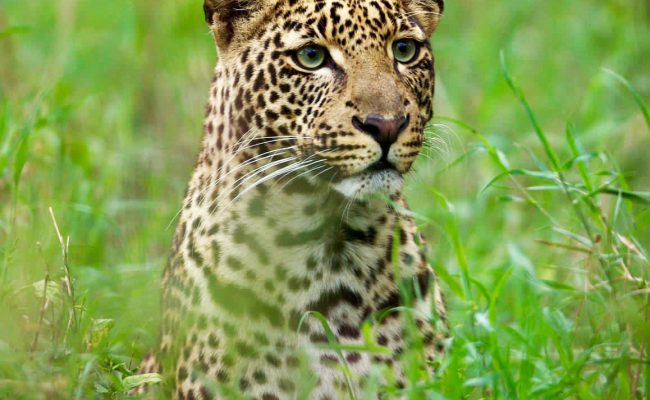
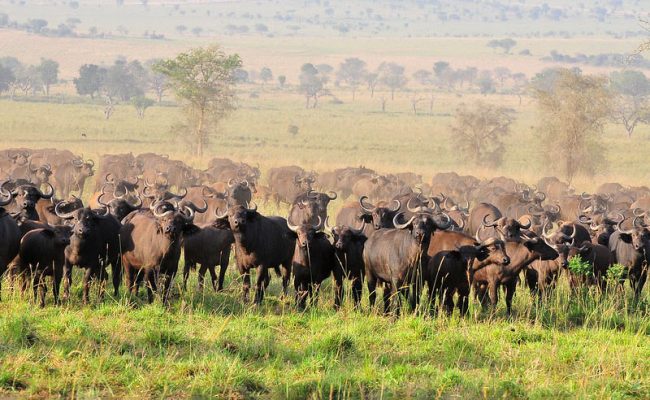
Kibale National Park in western Uganda earns its title as the Primate Capital of the World not through marketing but through biology. The park protects 795 square kilometres of moist evergreen and semi-deciduous forest at altitudes between 1,100 and 1,600 metres — a forest so rich in fruit-bearing trees and so structurally diverse in its canopy architecture that it supports thirteen species of primate simultaneously, a concentration found nowhere else on earth. Chimpanzees are the headline — Kibale holds one of the largest and most stable chimpanzee populations in East Africa, estimated at over 1,500 individuals, with several communities habituated to human presence over decades of patient research work. But the forest’s primate wealth extends far beyond the chimpanzees — red colobus monkeys in troops of hundreds, L’Hoest’s monkeys, grey-cheeked mangabeys, olive baboons, black-and-white colobus, red-tailed monkeys, and the nocturnal pottos and bushbabies that the forest hides in its canopy after dark. Beyond the primates, over 375 bird species and a mammal list that includes forest elephant, buffalo, and leopard make Kibale one of Uganda’s most complete and rewarding wildlife destinations. The Fort Portal crater lakes that frame this itinerary add a landscape dimension of extraordinary beauty — over fifty explosion craters formed by ancient volcanic activity, many filled with water of stunning clarity, the surrounding crater walls cloaked in forest and tea plantation, creating a scenery that is unlike anything else in East Africa.
Day 1 — Kampala to Fort Portal & Afternoon Crater Lakes
Morning — The Drive West The journey from Kampala to Fort Portal covers roughly 300 kilometres and takes between four and five hours through some of Uganda’s most varied and beautiful countryside. The road west passes through the rolling hills of central Uganda — densely settled, intensively farmed, the roadside a continuous procession of small towns, market stalls, boda-boda motorcycles, and the particular organised chaos of Ugandan rural commerce — before climbing into the tea-growing highlands west of Mubende where the landscape opens into something more expansive and dramatically beautiful. The Rwenzori Mountains — the legendary Mountains of the Moon, permanently snow-capped despite sitting almost exactly on the equator — appear on the western horizon as the road descends toward Fort Portal, their upper slopes wreathed in cloud and their glaciated peaks occasionally visible on clear mornings in a sight so improbable — snow on the equator — that it retains its power to astonish however many times it has been seen. Fort Portal itself is a pleasant, compact highland town with a genuine character — the Tooro Kingdom’s royal palace sits on a hill above the town, the market is vivid and well-stocked, and the surrounding landscape of crater lakes visible from almost every elevated point gives the town a setting of unusual beauty.
Afternoon — Crater Lakes Drive & Exploration The Fort Portal crater lakes region contains over fifty individual explosion craters — formed when rising magma met underground water and exploded rather than erupting, leaving perfectly circular depressions in the landscape that filled over millennia with rainwater and groundwater to create the extraordinarily clear, deep lakes that define the area’s character today. The afternoon of day one is devoted to exploring this landscape — a crater lakes drive that winds through tea estates and forest patches, stopping at viewpoints above individual lakes whose names carry a poetry appropriate to their beauty. Lake Nkuruba — small, circular, and surrounded by forest that comes directly to the water’s edge, home to a community of black-and-white colobus and red-tailed monkeys visible from the shore — is one of the most intimate and beautiful of the smaller lakes. Lake Nyinambuga offers perhaps the most dramatic viewpoint — a crater rim overlook from which the full circular geometry of the explosion crater is visible, the deep green water far below, the crater walls forested and steep, the scale of the volcanic event that created it suddenly and viscerally comprehensible. Lake Saka and Lake Kyaninga — both larger and accessible for swimming in their clear waters — complete a crater lakes introduction that prepares the eye and the imagination for the forest experience that begins the following morning.
Sunset — Rwenzori Views & Lodge Arrival The lodges serving the Fort Portal area range from the exceptional Kyaninga Lodge — perched on the rim of Lake Kyaninga crater with views that are among the finest in Uganda — to the well-regarded Ndali Lodge above Lake Nyinambuga, and several excellent mid-range options in and around Fort Portal town. Arriving at the lodge in time for the sunset — the Rwenzori Mountains catching the last light on their snow-capped peaks while the crater lakes below fill with shadow — is an arrival of genuine drama and beauty. Dinner on a crater rim, the sounds of the forest rising from the lake below, the equatorial night arriving quickly as it always does at this latitude, is the perfect close to a day of travel and landscape discovery.
Day 2 — Chimpanzee Tracking in Kibale Forest
Pre-Dawn — Preparation & Briefing The chimpanzee tracking day begins before sunrise with the kind of focused anticipation that only the truly wild and genuinely uncertain can produce. By 7am — the standard reporting time at the Uganda Wildlife Authority briefing point at Kanyanchu — groups of six to eight visitors have assembled with their guides and rangers for the pre-trek briefing. The briefing covers the protocols that decades of primate research and conservation management have developed — maintaining a minimum eight-metre distance from the chimpanzees, no flash photography, no eating or drinking near the animals, turning away from the chimpanzees if unwell, moving slowly and quietly, and above all following the guide’s instructions immediately and without question when the chimpanzees are located. These protocols exist to protect both the chimpanzees — whose immune systems have no resistance to many human pathogens — and the visitors, since chimpanzees are strong, fast, unpredictable, and capable of genuine aggression when they feel threatened. Understanding this before entering the forest transforms the encounter from a wildlife viewing experience into something that feels appropriately mutual and respectful.
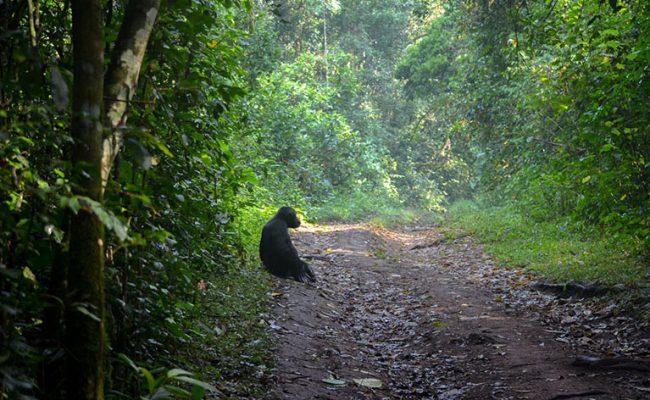
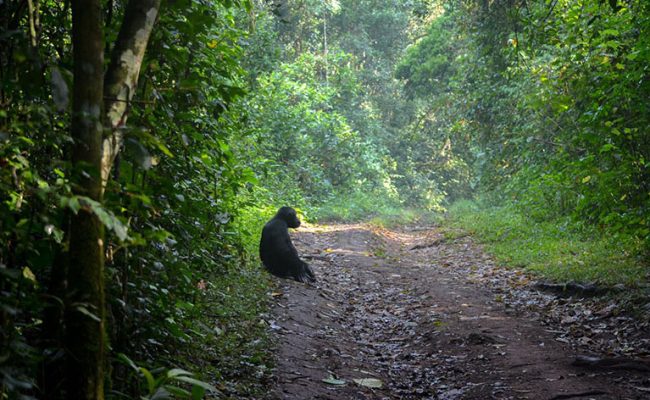
Morning — Into Kibale Forest The forest receives you immediately and completely. Within fifty metres of the Kanyanchu trailhead the canopy closes overhead, the temperature drops several degrees, and the sounds of the outside world — the road, the distant town — disappear entirely. Kibale’s interior is a world of extraordinary green complexity — the forest floor carpeted in shade-tolerant herbs and seedlings, the mid-canopy dense with climbing plants and epiphytes, the upper canopy a cathedral of interlocking crowns filtering the equatorial light into something soft and diffused and green. The guides and trackers — many of them with twenty or more years of experience in this specific forest, their knowledge of individual chimpanzee personalities, group dynamics, and territorial ranges accumulated over careers spent entirely in Kibale — move with a quiet purposefulness that is itself instructive. They listen as much as they look. The forest communicates constantly to those who know how to receive it — a branch moving without wind, a fig tree with fresh feeding damage, the distant sound that could be nothing or could be the beginning of everything.
The Encounter — Chimpanzees in the Wild When the chimpanzees are found — and Kibale’s habituated communities are located on the vast majority of tracking days, making this one of the most reliably successful primate tracking experiences in Africa — the encounter that follows is electrically, immediately different from any other wildlife experience. Chimpanzees are not calm. They are not serene. They are not the reflective philosophical beings of popular imagination. They are loud, fast, socially complex, politically sophisticated, physically powerful, and deeply, recognizably emotional in a way that no amount of intellectual preparation for the genetic proximity fully anticipates. A dominant male displaying — charging through the undergrowth, dragging branches, screaming with a volume that seems impossible from a body that size — is a physical event felt in the chest as much as heard with the ears. Females with infants move through the canopy with a focused, purposeful efficiency, the babies clinging with extraordinary grip strength, their faces wearing an expression of wide-eyed engagement with the world that is heartbreakingly familiar. The grooming sessions — two individuals sitting together, picking through each other’s hair with focused attention, the recipient wearing an expression of complete contentment — are among the most socially complex and most humanly readable behaviours in the animal kingdom. The full permitted hour with the chimpanzees passes in what feels like ten minutes. The walk back to the trailhead afterward is quieter than the walk in — people processing something that has happened to them rather than merely something they have observed.
Afternoon — Primate Walk & Forest Birding The afternoon in Kibale belongs to the forest’s other primate residents — a guided primate walk through a different section of the forest that targets the remarkable diversity of species beyond the chimpanzees. The red colobus monkey of Kibale — the Ugandan red colobus, a subspecies of particular richness and beauty — moves through the canopy in troops that can exceed 200 individuals, their rufous backs and white faces visible through the canopy in flickering glimpses as the troop moves. The grey-cheeked mangabey — a large, long-limbed monkey with extraordinary acrobatic ability — descends occasionally to the forest floor in search of fallen fruit, providing unusually close views of a species that typically stays high in the canopy. L’Hoest’s monkey — a dark, short-limbed species with a distinctive white bib — is one of Kibale’s most localised species, a forest interior specialist rarely seen outside intact primary forest. The forest birding woven through the afternoon primate walk adds species of considerable quality — African pitta on the forest floor, green-breasted pitta in the understory, the various Kibale forest robins and flycatchers that make experienced birders detour specifically to this forest. African grey parrots — increasingly rare across their range due to trapping for the pet trade — fly over in pairs and small groups, their grey plumage and scarlet tails briefly visible through canopy gaps.
Evening — Forest Sounds & Night Walk An optional guided night walk from the lodge or camp into the forest edge introduces the nocturnal dimension of Kibale’s primate world. The potto — a slow-moving, nocturnal prosimian related to the lorises of Asia — is located by eyeshine from the guide’s headlamp, its reflective eyes gleaming from a branch in the mid-canopy as the animal freezes in the torch beam with the evolutionary confidence of an animal whose camouflage and stillness have protected it from predators for millions of years. Thomas’s bushbaby — smaller, faster, and more acrobatic than the potto — moves through the canopy edge in quick bounds, its enormous eyes adapted for the near-total darkness of the forest interior. The night forest sounds are extraordinary — a complete sonic world that the daytime experience only partially reveals, the various nightjars, owls, and invertebrates building a soundscape of such complexity and beauty that simply standing still and listening is a fully sufficient activity.
Day 3 — Bigodi Wetland Sanctuary & Crater Lakes
Morning — Bigodi Wetland Sanctuary Bigodi Wetland Sanctuary — a community-managed conservation area on the edge of Kibale National Park, run by the Kibale Association for Rural and Environmental Development — is one of Uganda’s finest community conservation success stories and one of the most rewarding half-day wildlife experiences in western Uganda. The sanctuary protects a papyrus swamp and forest edge habitat along the Mpanga River that supports an extraordinary concentration of birds and primates in a relatively small area. A guided walk through the sanctuary — led by local community guides whose knowledge of the wetland’s wildlife has been developed over years of daily engagement — delivers a birding experience of remarkable quality. The great blue turaco — one of Africa’s most spectacular birds, an enormous turaco the size of a small turkey with brilliant blue, green, and yellow plumage — moves through the forest edge canopy with surprising stealth for its size, its deep resonant call carrying across the wetland. Black-and-white casqued hornbill, African broadbill, blue-throated roller, and the various papyrus specialists of the wetland margin — papyrus yellow warbler, white-winged warbler, Carruthers’s cisticola — build a morning list of considerable quality. The primates of Bigodi — red colobus, red-tailed monkey, black-and-white colobus, grey-cheeked mangabey, and the occasional chimpanzee moving through the sanctuary from the adjacent national park — provide a primate experience that complements the previous day’s forest tracking with a different habitat and a more relaxed, community-guided atmosphere. The community benefit from Bigodi’s tourism revenue — funding school scholarships, medical care, and local infrastructure — is directly visible in the sanctuary’s management quality and the guides’ depth of knowledge, making the visit feel genuinely purposeful beyond its considerable wildlife value.
Midday — Fort Portal Town & Tooro Kingdom A midday stop in Fort Portal town adds cultural depth to a journey that has so far been entirely focused on natural history. The Tooro Kingdom — one of Uganda’s traditional kingdoms restored after abolition during the Milton Obote era — has its palace on the hill above Fort Portal, and a visit to the Tooro cultural centre provides context for the kingdom’s history, its relationship with the surrounding landscape, and the Batooro people’s traditional ecological knowledge of the crater lakes and forests that their kingdom encompasses. The Fort Portal market — selling produce from the surrounding crater lakes farms, fresh fish from Lake Albert, Rwenzori honey, and the remarkable variety of bananas for which western Uganda is famous — is a vivid and photogenic midday stop that grounds the natural history focus of the itinerary in the human culture that has always been part of this landscape.
Afternoon — Lake Nkuruba Nature Reserve Lake Nkuruba — a small, perfectly circular crater lake surrounded by community forest — provides the afternoon with a combination of swimming, primate watching, and sheer landscape beauty that is one of the most quietly perfect experiences the Fort Portal region offers. The community-managed forest around the lake supports a habituated troop of black-and-white colobus monkeys that descends to the lower canopy in the afternoon and provides unusually close and unhurried views — the colobus’s extraordinary flowing black-and-white cape, its bearded face, and the infants’ pure white natal coats creating one of the most visually striking primate encounters available in Uganda outside the great ape experiences. Swimming in Lake Nkuruba’s clear water — the lake is bilharzia-free, its crater isolation protecting it from the snail host that carries the parasite — with colobus monkeys watching curiously from the trees above and the crater walls rising steeply on all sides is an experience of rare and complete pleasure. The afternoon light on the crater lake in the hours before sunset turns the water from green to gold to copper, and the sounds of the forest — the colobus’s roaring chorus call, the various forest birds settling for the night — create a soundscape that seems designed for the specific acoustics of the crater bowl.
Evening — Sundowner Above the Lakes The sundowner on day three belongs to the crater lakes landscape at its most expansive — a high viewpoint above Fort Portal from which multiple crater lakes are visible simultaneously, the Rwenzori Mountains catching the last light in the west, the tea estates on the crater slopes turning gold, and the forest patches between the craters darkening into the blue-green of approaching evening. This is one of Uganda’s great views, and the Fort Portal crater lakes at sunset in the company of good guides and cold drinks is the kind of travel moment that photographs cannot adequately contain and memory holds with unusual fidelity.
Day 4 — Chimpanzee Habituation Experience & Departure
Dawn — Chimpanzee Habituation Experience Day four opens with Kibale’s most immersive and most demanding primate experience — the Chimpanzee Habituation Experience, or CHEX, which differs fundamentally from the standard chimpanzee tracking permit in both duration and character. While the standard tracking permit allows one hour with a fully habituated community, the habituation experience joins the researchers and rangers working with a chimpanzee community that is still in the process of becoming accustomed to human presence — a process that takes years of patient daily contact. The CHEX permit allows participants to spend the entire day with the chimpanzees from the moment they leave their night nests at dawn to the moment they build new nests at dusk — six to eight hours of continuous contact with wild chimpanzees whose behaviour is completely unmodified by the presence of humans because their habituation is still incomplete. This means the full range of chimpanzee behaviour — hunting, territorial boundary patrolling, dominance displays, mating, infant care, tool use, social conflict and reconciliation — is potentially observable across the course of a full day. It is physically demanding — the chimpanzees move fast and the terrain of Kibale’s interior is not always cooperative — and it is emotionally and intellectually exhausting in the best possible sense, the sheer density of behaviour and interaction across a full day requiring sustained attention and producing an understanding of chimpanzee social life that a one-hour encounter simply cannot approach. For visitors with a serious interest in primatology, conservation, or simply in the deepest possible engagement with wild chimpanzees, the CHEX experience is transformative in a way that standard tracking, excellent as it is, is not.
Afternoon — Departure to Kampala or Queen Elizabeth The drive back toward Kampala in the afternoon — or onward south to Queen Elizabeth National Park for those extending their Uganda itinerary — carries the particular quality of departure from a place that has delivered fully and generously on every promise it made. The chimpanzee encounters, the crater lakes, the primate diversity of the forest, the community conservation of Bigodi, and the sheer beauty of the Fort Portal landscape combine into a four-day experience whose parts are individually excellent and whose whole is considerably greater than their sum. The Rwenzori Mountains recede in the rearview mirror as the road climbs east toward the Ugandan plateau, their snow-capped peaks — the Mountains of the Moon, source of the Nile according to the ancient geographers, real and present and magnificent — catching the afternoon light one final time before the road curves and they disappear, leaving the memory of a journey into one of Africa’s most extraordinary and most underappreciated wildlife destinations to settle slowly into something permanent and irreplaceable.
Practical Notes
Chimpanzee Tracking Permits cost $200 USD per person for the standard one-hour experience and $250 USD for the Chimpanzee Habituation Experience, both booked through the Uganda Wildlife Authority. Permits sell out well in advance during peak season — June through September and December through February — and advance booking of at least three to six months is strongly recommended.
Best Season follows Uganda’s general pattern — the dry seasons of June to September and December to February offer the most reliable tracking conditions, with drier forest floors and more predictable chimpanzee movement patterns. The wet seasons bring their own rewards — the forest is extraordinarily lush and green, fruit availability is higher bringing more chimpanzees into accessible areas, and the birding reaches its peak with the arrival of intra-African migrants.
Physical Requirements for chimpanzee tracking are moderate — the forest terrain is uneven and can be slippery in wet conditions, and the chimpanzees move at their own pace without consideration for human fitness levels. Reasonable cardiovascular fitness and sturdy waterproof footwear are the essential requirements. The CHEX full-day experience demands a higher fitness level and genuine stamina.
Combining with Other Destinations — Queen Elizabeth National Park immediately south of Kibale for tree-climbing lions and savannah wildlife, Bwindi Impenetrable Forest further south for mountain gorilla trekking, or Murchison Falls National Park to the north for Nile river safaris and northern savannah species — transforms the Kibale visit from a standalone trip into part of one of Africa’s most diverse and rewarding multi-destination itineraries.


 Email us bookings@twijaafrica.com
 Call us +256 777 559835