12 DAYS H0NEYMOON TANZANIA + ZANZIBAR CLONE
ARUSHA — Where Love Meets the Wild
Arusha receives you like the opening chapter of a story you already know will be unforgettable. The city sits at 1,400 metres in the cool highland air between two great volcanoes, wrapped in the scent of coffee and bougainvillea, alive with colour and movement and the particular electricity of a place that exists at the edge of something immense. For two people arriving together at the beginning of a shared life, there is something deeply fitting about starting here — in a city that is itself a threshold, a gateway, a place of beautiful anticipation. The drive from Kilimanjaro International Airport winds through banana plantations and small market towns, past women carrying impossible loads on their heads with extraordinary grace, past children in school uniforms waving from red dirt roadsides, past the first distant glimpse of Kilimanjaro’s glaciated crown floating above the clouds like a vision from another world. Your first evening in Arusha belongs to each other — a candlelit dinner on a terrace in the hills, the city lights spreading below, Mount Meru’s silhouette black against a sky so full of stars it seems to press down toward you, warm and close and infinite. This is where your honeymoon begins. Everything from here is wonder.
ARUSHA NATIONAL PARK — A Morning in Paradise
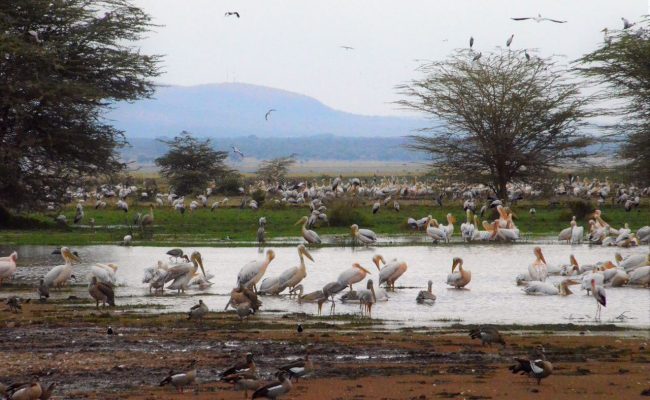
Your first morning in the wild is gentle and intimate and perfect. Arusha National Park, just thirty minutes from the city, is small enough to feel personal — a private garden rather than a vast wilderness — and it is exquisitely beautiful in the early light. You enter the park as the sun is still low, the forest track dappled with gold and shadow, and almost immediately the black-and-white colobus monkeys appear overhead, their long white capes drifting as they move through the canopy with a slow, theatrical grace that seems almost performative, as though they know they are being watched and have decided to make the most of it. The forest opens onto the Momela Lakes, their surfaces perfectly still in the morning calm, reflecting the pink of the sky and the white shapes of pelicans drifting like paper boats. Giraffes move against the treeline with their characteristic slow-motion elegance, and beyond them, on those rare crystalline mornings, both Mount Meru and Kilimanjaro are visible simultaneously — two great volcanoes presiding over the landscape like quiet, ancient witnesses to everything that happens below. A canoe safari on the lakes, just the two of you in the morning silence, with hippos surfacing nearby and a malachite kingfisher hovering above the water in a flash of electric blue, is an experience of such uncomplicated, undiluted beauty that it requires nothing — no words, no photographs, no context — only presence.
KILIMANJARO — Standing at the Foot of Africa
No honeymoon in northern Tanzania is complete without a morning in the presence of Kilimanjaro. Africa’s greatest mountain rises from the surrounding plains not gradually, as most mountains do, but all at once — a single, vertiginous sweep of 5,895 metres from flat savanna to glaciated summit, the whole improbable structure floating above the clouds in a silence so complete it feels almost sacred. You do not need to climb it to feel its power working on you. Drive through the lower forest zones where the trees are enormous and ancient and draped in moss, where cape buffalo move like dark water through the undergrowth and the air is cool and green and faintly electric, and simply allow the mountain’s presence to settle over you — that particular combination of beauty and immensity and permanence that only the truly great natural wonders of the world can produce. Standing together at the foot of the highest free-standing mountain on Earth, feeling small in the best possible way, is a beginning that puts everything that follows — every year, every challenge, every ordinary Tuesday — in the perspective of something larger and wilder and more enduring than either of you alone.
TARANGIRE NATIONAL PARK — Giants in the Golden Light
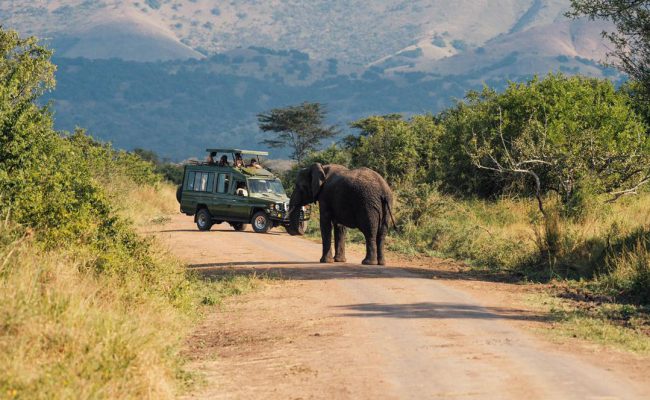
Tarangire is where the safari reveals its full, intoxicating power for the first time. You cross into the park and the landscape changes immediately — the red earth, the immense sky, and everywhere the baobab trees, those ancient, swollen, magnificent giants that have been standing in this same soil for over a thousand years, watching the seasons turn and the herds pass and the world change around them with a patience so vast it borders on the philosophical. In the dry season the Tarangire River draws every living thing within a hundred kilometres — and what arrives is overwhelming. Elephant herds of extraordinary size move to the water in the late afternoon light, the dust rising around them in red clouds, the sound of their movement a deep, felt vibration in the chest before it becomes something audible. To sit together on the roof of a game vehicle as the sun drops behind the baobabs and the elephants come down to drink — the calves scrambling between their mothers’ legs, the great bulls standing at the river’s edge with their trunks trailing in the water, the whole scene bathed in a light so golden and warm it seems to come from inside the landscape rather than above it — is one of those moments that marriages are built around. Not the grand gestures. The shared witnessing of something so beautiful it stops time.
LAKE MANYARA — The Romantic Rift
Lake Manyara is a park made for slow, unhurried exploration — which makes it ideal for two people who are in no particular hurry to be anywhere except exactly where they are. The drive into the park passes through a groundwater forest of extraordinary density and beauty, the trees so tall and close together that the light filters through in shifting, cathedral-like shafts, and the air is cool and moist and alive with birdsong. Elephant families move through the shadows with that paradoxical combination of great size and complete silence. Blue monkeys cascade through the canopy. Enormous baboon troops settle into the trees around you with the casual familiarity of neighbours. And then the forest opens, all at once, onto the lake — vast and silver and impossibly calm, its margins pink with flamingos that extend for kilometres in both directions, its surface broken only by the distant shapes of pelicans riding the thermals above the water. The Rift Valley escarpment rises behind you, six hundred metres of ancient layered rock glowing amber in the afternoon sun, and the whole scene — the lake, the flamingos, the escarpment, the soft light, and the two of you standing together at the edge of all of it — has a quality of composed, painterly perfection that feels almost too beautiful to be accidental.
NGORONGORO CRATER — The Garden of Eternal Wonder
There are places in the world that seem to exist specifically to remind human beings of their proper scale in the order of things — places so enormous in their beauty, so complete in their wildness, so overwhelming in their perfection that the ordinary preoccupations of daily life simply dissolve in their presence. The Ngorongoro Crater is one of those places. You descend into it in the early morning, the vehicle winding down the steep crater wall through cloud forest that drips with moisture and silence, and then the forest falls away and the crater floor opens below you — 260 square kilometres of enclosed paradise, the grassland gold and green in the first light, the hippo pool dark and steaming, the soda lake shimmering silver at the far edge of the caldera, the whole impossible world ringed on every side by walls that rise six hundred metres into the morning sky. A picnic lunch on the crater floor, with lions resting fifty metres away and zebra grazing in the middle distance and the crater walls curving around you like the arms of the earth itself, is a romantic experience so far outside the vocabulary of conventional romance that it invents its own language entirely. And when a black rhino appears in the late morning light — massive and solitary and prehistoric, moving with a slow deliberateness across the open plain — and the two of you watch in complete silence as this rarest of creatures passes through your shared field of vision, you understand that you are witnessing something that very few people alive will ever see, and that this moment, this specific convergence of place and time and the particular luck of being exactly where you are together, belongs to you and to no one else.
🦁 SERENGETI — Love on the Infinite Plain
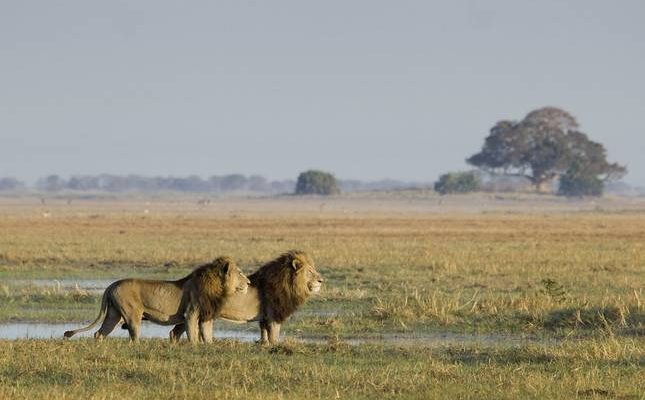
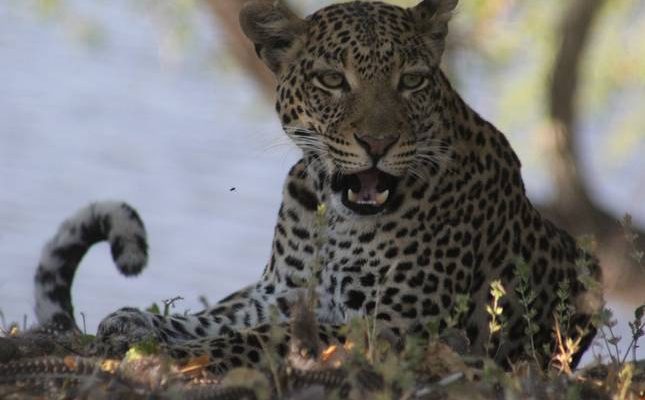
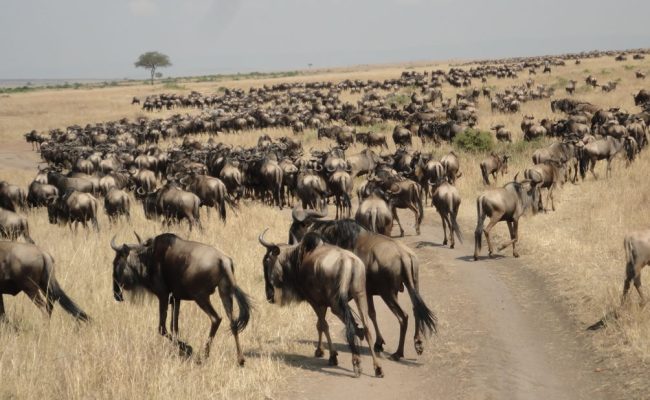
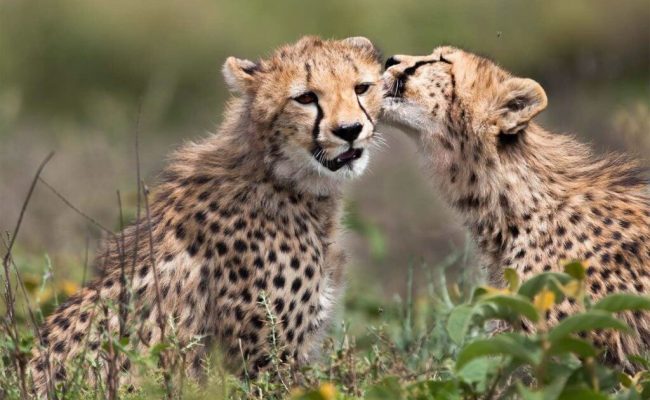
The Serengeti on a honeymoon is not a romantic backdrop. It is something far more profound than that. It is a place that strips everything back to its essentials — life and death, movement and stillness, the individual and the infinite — and in doing so creates a kind of clarity that is enormously useful at the beginning of a shared life. You cross the boundary and the land opens in every direction without limit, the sky doubling in size, the horizon receding to a distance that seems to curve with the earth, and the immediate, instinctive response is a loosening — of tension, of self-consciousness, of the accumulated noise of modern life — that feels like the best kind of relief. The mornings in the Serengeti are among the most beautiful things on Earth. You leave camp before dawn, the air cold and sharp at altitude, the stars still bright above the acacia canopy, and drive out onto the plain as the sky begins its daily transformation — black to deep purple to the most extraordinary burning rose and gold — and by the time the sun clears the horizon the world is already impossibly, almost aggressively beautiful. A cheetah mother leads her three cubs across the open grass in the first light, teaching them the geometry of the hunt. A leopard drops from a sausage tree with the fluid, boneless grace of something made entirely of muscle and intention. A lion pride stirs on a kopje, the great males yawning to reveal pink mouths and yellow teeth, the cubs tumbling over each other in the morning warmth. On a private balloon safari — the ultimate Serengeti experience — you drift above all of it in the early light, the basket swaying gently, the shadow of the balloon moving across the grass below, the wildebeest parting around it like a brown sea, the whole vast landscape laid out beneath you in a silence so complete and a beauty so absolute that the only appropriate response is to reach for the hand beside you and hold it, and say nothing at all.
ZANZIBAR — The Island of Perfect Endings and New Beginnings
And then the Indian Ocean. After the dust and the early mornings and the magnificent, exhilarating intensity of the safari, Zanzibar receives you like a long exhale — warm, salt-scented, luminous, and unhurried in the way that only islands surrounded by water this colour can be. The flight from the mainland takes forty minutes and crosses a channel of water that moves through every possible shade of blue — turquoise over the reef, cobalt in the deep water, a blinding silver where the afternoon sun hits the surface at the right angle — and then the island appears below, green and coral-fringed and ancient, and the world slows down to match your heartbeat. Stone Town is where you begin — wandering together through alleyways so narrow you must walk single file, past carved wooden doors five centuries old, past the scent of cloves and cardamom drifting from the spice market, past the blue harbour where traditional dhows bob on water the colour of shallow tropical sea. The Forodhani night market is where Stone Town reveals its most seductive self — tables laid out under the stars along the waterfront, vendors grilling lobster and octopus and Zanzibar pizza over charcoal, the warm salt air carrying the sound of music from somewhere deeper in the old city, the harbour lights reflected in the dark water below the seawall. And then the beach. Your private beach villa sits at the edge of the Indian Ocean, the kind of place that exists to make the rest of the world feel temporarily irrelevant — a long white arc of sand that is yours alone in the early mornings, the water so warm and clear and impossibly turquoise that swimming in it feels less like swimming and more like floating inside a precious stone. You snorkel above coral gardens alive with hawksbill turtles and parrotfish and clouds of electric-blue damselfish. You eat grilled seafood at candlelit tables on the sand with your feet bare and the sound of the ocean just beyond the candlelight. You watch the dhow silhouettes move across the sunset like cutouts from a more beautiful version of the world. And in the evenings, when the sky turns from gold to rose to the deep, star-thick African dark, and the ocean makes its eternal sound against the coral, and there is nowhere else on Earth you need to be and no one else in the world you would rather be beside, Zanzibar gives you the most generous gift an island can give two people at the beginning of their life together — the gift of complete and absolute and uncomplicated happiness, held still for just long enough to be felt all the way through.
3 Days Akagera National Park Wildlife Safari
4 Days Zambia-Livingstone Explorer
Namibian Adventure (Camping) 5 Days / 4 Nights
6 Days South Sudan Cultural Tour – Lopit, Buya, Mundari, and Lotuko (Otuho) Tribes
5 Days Northern Parks Extension
7 Days Safari Tanzania
18 Days Tanzania Safari + Zanzibar (Wildebeest Migration)
9 Days Rwanda Gorilla Experience & Safari
10 Days Exploring the Wonders of Zambia
11 Days Safari Trip Tanzania + Zanzibar
12 Days Luxury South Luangwa, Lower Zambezi & Victoria Falls


 Email us bookings@twijaafrica.com
 Call us +256 777 559835