3-Day Akagera National Park Wildlife Safari — Rwanda
Three full days in Rwanda’s only savannah park — enough time to move beyond the highlights and into the deeper rhythms of an ecosystem that has pulled off one of conservation’s most remarkable and most moving comebacks anywhere in Africa.
Akagera — The Full Story
Akagera National Park occupies Rwanda’s northeastern corner along the Tanzanian border, its eastern boundary defined by the Akagera River and its associated chain of lakes that give the park its name and its most distinctive geographical character. The park covers 1,122 square kilometres of varied savannah habitat — open grassland, dense woodland of acacia and mixed miombo, papyrus swamps and seasonal marshes, rocky hills with panoramic views across the lake chain, and the permanent lakes themselves that thread through the park’s eastern sector like a string of irregular mirrors reflecting the enormous East African sky. Understanding Akagera fully requires understanding its history, because the wildlife you encounter across three days exists not merely because the habitat supports it but because an extraordinary effort of conservation will and financial investment has rebuilt an ecosystem that came within a generation of complete collapse. After the 1994 genocide, the park was reduced from over 2,500 square kilometres to its current area as displaced communities settled within its original boundaries. Wildlife populations that had already been under pressure from poaching collapsed further as the country’s institutions failed and the park lost both funding and protection. Lions disappeared. Rhinos disappeared. Elephants were reduced to a tiny remnant population. By the early 2000s Akagera was a park in name only — the habitat remained but the ecological community that had defined it was largely gone. The partnership between the Rwanda Development Board and African Parks — which took over management in 2010 — has reversed this collapse with a speed and completeness that surprises even those familiar with African Parks’ remarkable track record across the continent. Lions reintroduced in 2015 are now breeding and establishing territories. Black rhinos reintroduced in 2017 are moving freely across the park. Giraffes reintroduced in 2021 are settling into their new landscape. The elephant population has recovered. And the broader wildlife community — buffalo, zebra, topi, impala, hippo, crocodile, hyena, leopard — has responded to improved protection by expanding across the park in ways not seen for decades. Three days in Akagera is three days inside a living conservation success story, and that context gives every wildlife encounter a resonance beyond its immediate visual impact.
Day 1 — Arrival & Southern Sector Game Drive
Morning — Transfer from Kigali The drive from Kigali to Akagera’s main Gabiro gate covers roughly 100 kilometres northeast through the Rwandan highlands — the thousand hills of the country’s defining topography rolling in every direction, densely terraced and intensively cultivated, the landscape bearing the marks of one of the most densely populated countries in Africa managing its agricultural land with extraordinary care and precision. The road descends gradually from the highland plateau toward the Akagera Valley, the vegetation becoming progressively drier and more savannah-like as the altitude drops and the rainfall shadow of the highlands asserts itself. The transition from highland agriculture to park boundary is managed through a community buffer zone where local farmers grow crops and graze cattle alongside the park’s electric fence — a boundary that represents both a physical division between human and wildlife land and a managed interface where conservation and community development must coexist productively for the park’s long-term security. Passing through the Gabiro gate, the landscape shifts immediately — the cultivated hillsides replaced by open savannah grassland, the road narrowing to a track, the first wildlife visible within minutes as impala graze the open ground beside the gate.
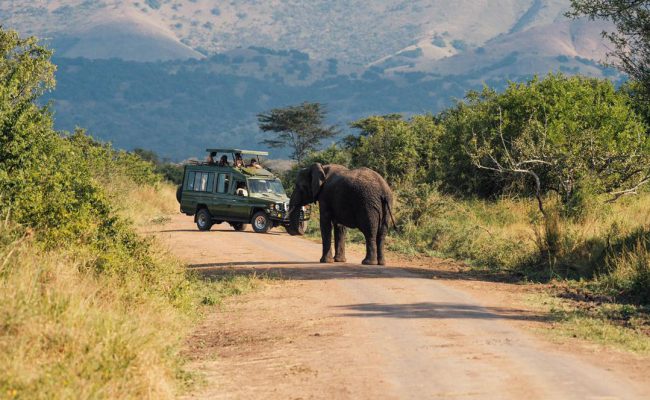
Afternoon — Southern Lakes Circuit The southern sector of Akagera is defined by the lake chain — Lakes Ihema, Shakani, and Rwanyakazinga threading through the parkland in a sequence of open water and papyrus-margined bays that concentrate wildlife and waterbirds in extraordinary diversity. The afternoon game drive sweeps through this southern sector along the elevated ridge roads that run above the lake chain, the views from these roads extending across the water to the Tanzanian hills beyond in a panorama of extraordinary scale and beauty. Hippo pods are immediately visible from the ridge road — large groups of twenty, thirty, forty animals packed into the lake shallows, their backs and ears and eyes barely breaking the surface, the occasional eruption of territorial displeasure sending spray across the surrounding pod with impressive force. Nile crocodiles — enormous, ancient, utterly prehistoric in their stillness — bask on the sandy banks between the papyrus stands, their complete motionlessness making them initially invisible until the eye learns to find the geometric regularity of the scute pattern in the otherwise organic tangle of the bank vegetation. Buffalo herds move across the open grassland above the lake, their heavy heads swinging as they graze, the oxpeckers on their backs a constant reminder of the symbiotic relationships that make savannah ecosystems function as integrated wholes rather than collections of independent species. The first elephant sightings of the afternoon — family groups moving between the woodland edge and the lake shore — carry a particular satisfaction given the species’ near-disappearance from Akagera in the post-genocide years, their calm presence in the current landscape a direct measure of the park’s recovery.
Sundowner — Lake Ihema View The sundowner stop above Lake Ihema — the largest of Akagera’s permanent lakes — catches the afternoon light at its most dramatic, the water turning gold and then copper as the sun drops behind the western hills, the hippos silhouetted against the reflected light, the papyrus darkening on the margins, and the evening flight of egrets and open-billed storks beginning their return to communal roosts in long white streams across the orange sky. Cold drinks, the particular quietness of a game drive ending well, and the knowledge that two full days of this landscape remain — it is a satisfying first evening in a park that has been building its case for attention all afternoon.
Accommodation — Within the Park Akagera’s two primary lodges — Ruzizi Tented Lodge on the lake shore and Mantis Akagera Game Lodge on the elevated ridge — both sit within the park boundary, surrounded by wildlife that moves freely through the camp areas after dark. Falling asleep to the sound of hippos grunting from the lake below and hyenas calling from the darkness of the acacia woodland behind the camp is the best possible reminder that the safari does not pause for human sleep schedules.
Day 2 — Full Day Deep Safari & Boat Safari
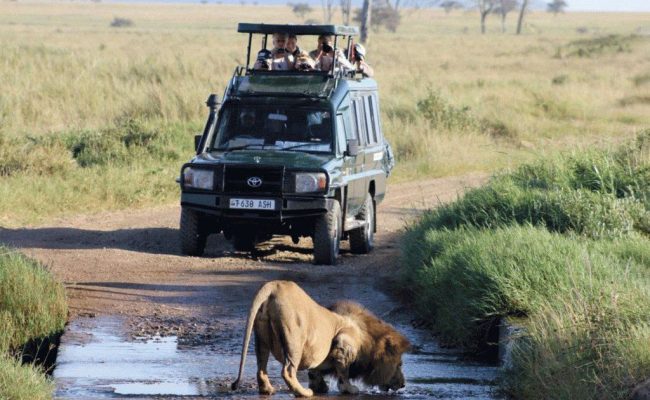
Pre-Dawn — Early Morning Game Drive The alarm before sunrise on day two is not a hardship — it is an invitation into the hour that Akagera gives most generously to those who claim it. The park opens at first light, and the game drive that begins in the blue pre-dawn darkness and extends through sunrise and into the full morning is consistently the most rewarding single game drive session of any Akagera visit. Predator activity peaks in the cool of early morning — lions that have been active through the night are sometimes still moving or feeding as the first light arrives, their amber eyes catching the headlights of the game vehicle in the pre-dawn darkness and then gradually becoming visible in their full physical reality as the sun brings colour back to the world. The reintroduced lion prides are now breeding across multiple family groups covering different territorial ranges within the park, and the guides who work Akagera daily develop tracking knowledge of individual pride movements and territorial boundaries that makes predator sightings more than luck — they are the product of accumulated spatial intelligence about specific animals in a specific landscape. Leopard — always present in Akagera but always elusive — moves through the woodland edges in the early morning with the fluid, low-bodied grace of a species that has survived millennia of human pressure by mastering invisibility, and the pre-dawn drive through the acacia woodland gives the best available chance of a sighting before the leopard retreats into the dense thicket cover where it spends the day invisible and entirely comfortable.
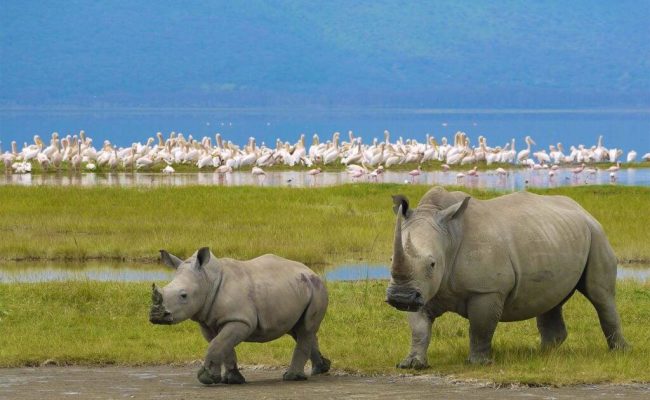
Morning — Northern Sector & Rhino Tracking The northern sector of Akagera — less visited, more topographically varied, with rocky hills and denser bush alternating with open valley grasslands — is where the reintroduced black rhino population has established its home ranges, and the morning of day two is devoted to a dedicated rhino tracking experience that is among the most meaningful wildlife encounters available in Rwanda. The black rhinoceros is one of the world’s most critically endangered large mammals — its global population reduced from an estimated 70,000 in 1970 to fewer than 6,000 today by decades of commercial poaching for its horn. Rwanda’s Akagera population — carefully sourced from European zoos maintaining insurance populations and from wild populations in southern Africa — represents a genuine contribution to the species’ survival, and the rangers who monitor and protect each individual animal daily are among the most dedicated conservation professionals in East Africa. Rhino tracking in Akagera is conducted with specialist rangers who maintain detailed knowledge of each rhino’s current location and movement patterns — the tracking process involves reading the landscape for signs of recent rhino presence, following footprints and vegetation disturbance, and moving carefully through dense bush with the awareness that a black rhino encountered unexpectedly at close range is a genuinely dangerous animal whose first response to perceived threat is often an immediate charge. The sighting itself — a black rhino in the African bush, an animal whose absence from this landscape for nearly two decades made its return a conservationist’s aspiration rather than an expectation — carries an emotional weight that experienced safari travellers consistently describe as among the most affecting wildlife encounters of their African experience.
Midday — Boat Safari on Lake Ihema The midday session moves from land to water — a boat safari on Lake Ihema that reveals Akagera’s character from a completely different perspective and delivers wildlife encounters that the land-based game drive cannot replicate. The boat moves slowly along the lake’s northern margins, the papyrus walls rising on both sides of the narrower channels, the open water of the main lake gleaming ahead. Hippo pods in the lake shallows regard the approaching boat with the particular combination of curiosity and mild irritation that characterises hippo responses to water-based intrusion — surfacing closer than they would to a land vehicle, their faces large and oddly expressive at close range, the territorial bulls occasionally making mock charges through the water that are simultaneously alarming and — at a safe distance — genuinely thrilling. The crocodile population of Lake Ihema is substantial and the boat allows close approach to individuals basking on the sandy banks that a land vehicle could not reach — enormous animals of four, five, six metres, their prehistoric stillness and their extraordinary evolutionary conservatism — essentially unchanged for 200 million years — giving them a quality of deep time that the more recently evolved mammals of the savannah cannot match. The bird life from the boat is extraordinary — African fish eagle calling from every prominent dead tree above the water, saddle-billed stork wading the shallows with dignified precision, African pygmy goose in the water lily beds, the various kingfisher species working the lake margins, and in the papyrus channels the possibility — always the possibility, never the guarantee — of the shoebill, that great prehistoric bird whose presence in Akagera’s papyrus swamps is one of Rwanda’s finest ornithological secrets.
Afternoon — Topi Plains & Predator Country The Topi Plains in Akagera’s central sector are the park’s most open savannah grassland — a sweep of short grass and seasonal wetland that supports the highest density of plains game in the park and consequently the most reliable predator activity. Topi — the large, dark chestnut antelope with the distinctive blue-grey face and hindquarters that gives the plains their name — stand on termite mounds using the elevation to scan for predators, their sentinel behaviour a reliable indicator of predator presence in the vicinity. Zebra herds move across the open grassland in their characteristic family group structure, the stallions maintaining position at the margins of the group, their awareness of the landscape’s predator content visible in the frequency and direction of their scanning. Reedbuck in the longer grass margins. Impala in their hundreds at the woodland edge. And over all of it the possibility — always present in the topi plains, always worthy of sustained attention — of a lion pride moving, hunting, or resting in the open grassland where the flat topography and short grass make sightings more reliable than anywhere else in the park. The afternoon drive through the topi plains as the light drops and the shadows lengthen across the grassland, the game becoming more active as the heat relents, is Akagera wildlife watching at its most classically East African.
Evening — Night Drive An evening game drive extending beyond sunset into darkness — where park regulations permit — introduces the nocturnal dimension of Akagera’s wildlife community that the daytime hours conceal. The spotlight sweeps the acacia woodland and grassland edge, finding the eyeshine of genets moving silently through the branches, civets crossing the track with their distinctive rolling gait, spring hares bounding across the open ground in their improbable kangaroo-like leaps. The night drive’s greatest prize is the African wild cat — the direct ancestor of the domestic cat, visually almost identical but behaviourally entirely wild — crossing the track in the spotlight beam with a look of absolute self-sufficiency that the ten thousand years of feline domestication have not entirely bred out of its household descendants. Nightjars rest on the warm track surface, their cryptic plumage making them invisible until the vehicle is almost upon them and they explode upward in a flutter of wings, their eyeshine visible for a moment before they resettle a hundred metres ahead and disappear again into perfect invisibility.
Day 3 — Morning Birding, Savannah Walk & Departure
Dawn — Dedicated Birding Session Akagera’s bird list exceeds 480 species — one of the highest totals of any East African national park — and the dawn of day three is devoted specifically to the ornithological dimension of the park that the previous days’ mammal focus has addressed only incidentally. The lake shore at first light is the most productive single birding location — the morning flight of cormorants and darters to their fishing grounds on the open water, the egret species feeding actively in the shallows, the kingfisher community working the lake margin, and in the papyrus the warbler and bishop species beginning their territorial song in the first light. Shoe billed stork is sought with genuine dedication in the deeper papyrus channels — the guide’s knowledge of specific recent sighting locations making the search systematic rather than random. Grey crowned crane — one of Africa’s most beautiful birds, its golden crown of stiff feathers, red and white facial pattern, and graceful proportions combining into an impression of regal elegance — moves in pairs across the open grassland above the lake, their bugling calls carrying across the morning air. African fish eagle is everywhere and never becomes commonplace — each sighting, each call, each aerial display above the water carrying the particular charge of a bird that has become so completely the sound and sight of East Africa that its presence is felt as confirmation of place rather than merely as another species sighting. The martial eagle — Africa’s most powerful eagle, capable of killing small antelope and monitor lizards — soars on the morning thermals above the woodland, its spotted underparts and fierce yellow eyes visible through binoculars as it circles at height. Lilac-breasted roller on every prominent perch, its extraordinary colour combination of turquoise, lilac, blue, and green catching the morning light with almost aggressive intensity. Secretary bird striding across the open grassland with its peculiar deliberate walk, its long central tail feathers trailing behind like a Victorian clerk’s quill. The dawn birding session builds a species list that adds genuine ornithological depth to a safari whose mammal content has already been exceptional.
Mid-Morning — Walking Safari The mid-morning session of day three introduces the most intimate and most physically engaging wildlife encounter available in Akagera — a guided walking safari through the acacia woodland and open grassland with an armed ranger guide whose knowledge of the landscape on foot, developed through years of daily professional engagement with the park, transforms the walk from a pleasant exercise into a genuinely revelatory experience. Walking in Akagera’s wildlife-rich savannah requires the particular quality of attention that the vehicle-based game drive does not demand — every sense engaged simultaneously, the ground surface read for tracks and signs, the vegetation scanned for movement, the wind direction constantly assessed for its implications for animal awareness of the walking group’s presence. The ranger reads the landscape with fluency that the vehicle-based drives only partially reveal — identifying the specific acacia species and explaining their ecological roles, interpreting the dung beetle’s industrious ball-rolling in terms of nutrient cycling across the savannah, explaining the termite mound architecture in terms of the extraordinary engineering of temperature regulation and ventilation that these structures achieve. Buffalo sign is read carefully and buffalo themselves are given respectful distance — the Cape buffalo is genuinely dangerous on foot, and the ranger’s management of buffalo encounters on the walking safari combines complete professionalism with an honest acknowledgment that this is wild country with wild animals that have not agreed to be safe. The walking safari’s most lasting contribution to the Akagera experience is not the species list it adds but the quality of attention it develops — the ability to see the savannah at a resolution that the vehicle’s speed and elevation prevents, and to feel the landscape as a physical presence rather than a moving backdrop to wildlife sightings.
Late Morning — Panoramic Viewpoint & Final Reflection The final game drive of the three days climbs to the elevated ridgeline in the park’s interior — the highest accessible point, from which the entire Akagera landscape is visible simultaneously in a panorama of extraordinary scope. The lake chain stretches southward along the Tanzanian border, each lake catching the late morning light in its own particular way. The woodland and grassland mosaic of the park’s interior spreads westward toward the distant hills. The Akagera River glimmers in the east, the international boundary invisible but implicit. And across this landscape — recovered, rewilded, protected by daily professional dedication and significant ongoing investment — the wildlife that has been the subject of three days of morning game drives and boat safaris and walking is going about its business with the magnificent indifference to human admiration that is always, in the end, the most reassuring thing about wild animals in a functioning wild landscape.
Afternoon — Return to Kigali The drive back to Kigali from Akagera takes roughly two hours along roads that are smooth, well-maintained, and lined with the green precision of the Rwandan countryside managing its land and its people with the particular purposeful efficiency that characterises this small, extraordinary country’s approach to almost everything it undertakes. The city receives returning safari travellers with its characteristic energy — clean, organised, ambitious, a capital that wears its recovery from extraordinary trauma with a forward-looking purposefulness that the international visitor finds simultaneously humbling and inspiring. The connection between Rwanda’s national recovery and the recovery of Akagera National Park — both projects of deliberate will, sustained investment, and refusal to accept the permanence of what had been destroyed — is not a metaphor that needs to be forced. It presents itself naturally to anyone who has spent three days in the park and pays attention to the country they are returning to.
Practical Notes
Park Fees & Permits are managed through the Rwanda Development Board and include a daily conservation fee, activity fees for the boat safari and rhino tracking, and vehicle fees. The rhino tracking experience in particular should be booked in advance through the RDB or through a specialist operator — the number of visitors permitted per rhino tracking session is deliberately limited to protect the animals and maintain the quality of the experience.
Best Season for Akagera wildlife viewing follows the general East African pattern — the dry seasons of June through September and December through February concentrate wildlife around permanent water, make tracks passable throughout the park, and provide the clearest conditions for game viewing. The wet seasons bring lush vegetation that makes the park dramatically beautiful but reduces visibility in the denser vegetation and makes some tracks impassable. The birding is exceptional year-round, with the wet season bringing additional species and greater overall activity.
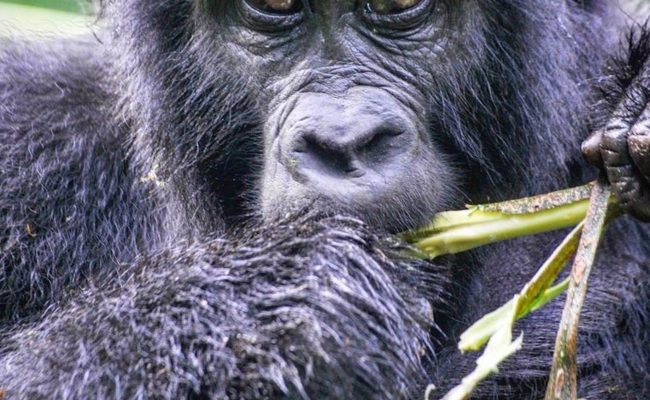
Combining with Volcanoes National Park — Rwanda’s other major wildlife destination, offering mountain gorilla trekking and golden monkey tracking in the northwest — creates a complete Rwanda wildlife itinerary of extraordinary contrast and complementary experience, the savannah and lake ecosystem of Akagera balanced against the misty montane forest and primate encounters of the Virunga highlands.
Physical Requirements for the standard game drive and boat safari elements are minimal. The rhino tracking involves walking through potentially dense bush at a pace set by the rangers and the rhinos’ current location — reasonable fitness and appropriate footwear are necessary. The walking safari requires moderate fitness and the ability to walk quietly and steadily through varied terrain for two to three hours.
Photography in Akagera rewards both the wide landscape work that the lake chain and open savannah invite and the close wildlife portraiture that the boat safari on Lake Ihema makes possible. The elevated ridge roads offer landscape photography opportunities of genuine quality — the lake chain, the savannah, and the enormous East African sky combining in compositions of breadth and drama that the park’s relatively modest fame has left largely unphotographed in international wildlife media.


 Email us bookings@twijaafrica.com
 Call us +256 777 559835