10 DAYS TANZANIA SAFARI ALL NORTHERN PARKS
ARUSHA — The Gateway
Arusha is where the dream begins. Perched at 1,400 metres in the shadow of Mount Meru, this highland city pulses with a particular kind of electric anticipation — the energy of people on the edge of something extraordinary. The air is cool and clean, scented with coffee from the surrounding plantations. Maasai warriors stride through the market streets in brilliant red shukas, their beaded jewellery catching the light, utterly unbothered by the chaos of matatu minibuses and safari vehicles swirling around them. The central market overflows with colour — pyramids of spices, bolts of kitenge fabric, mangoes stacked high as a man. Arusha is not just a transit point. It is a world unto itself, and it deserves a proper evening — cold Kilimanjaro beer on a restaurant terrace, the last light fading on Mount Meru’s cone above the rooftops, the sound of the city settling into night.
ARUSHA NATIONAL PARK — Three Worlds in One
Just half an hour from the city, the road ends and wilderness begins. Arusha National Park is small by Tanzanian standards — only 552 square kilometres — but it is one of the most dramatically varied landscapes on the continent. You enter through a tunnel of ancient fig trees, their roots gripping the red earth like giant fingers, the forest so dense and green and alive it feels almost prehistoric. Troops of black-and-white colobus monkeys, those spectacular primates with flowing white capes, leap between branches overhead. Elephants move silently through the undergrowth. The forest gives way to open moorland where giraffes cross against a backdrop of Mount Meru’s volcanic cone, and then suddenly the Momela Lakes appear — a chain of shallow, alkaline lakes shimmering with flocks of lesser flamingos that turn the water dusty pink. The big prize, on a clear morning, is the view across the park to Kilimanjaro rising above the clouds — two great volcanoes visible at once, an image so dramatic it seems almost artificially composed. A canoe safari on the lakes adds a dimension of intimacy that no game drive can match — paddling silently past hippos, watching a fish eagle plunge and rise, feeling the immensity of the sky reflected in still water.
MOUNT KILIMANJARO — The Impossible Mountain
There is something about Kilimanjaro that defies rational description. It rises not from a mountain range, not from foothills, but directly from the flat savanna plains — a solitary, enormous volcanic massif that seems to belong to another planet entirely. At 5,895 metres it is the highest free-standing mountain on Earth, and its summit glaciers — ancient and slowly retreating — glow white against an impossibly blue African sky. From the lower forest zones of Kilimanjaro National Park, where cape buffalo graze beneath giant tree heathers draped in old man’s beard moss, the scale of the mountain above you is almost incomprehensible. The rainforest at its base is dense and dripping, alive with the sound of colobus monkeys and Hartlaub’s turacos. Sunbirds dart between flowers. And above all of it, vanishing into the clouds, the mountain keeps its own counsel — ancient, silent, and absolute. You do not need to climb it to feel its power. Simply standing in its presence and looking up is an experience that stays with you for the rest of your life.
TARANGIRE NATIONAL PARK — The Kingdom of Baobabs and Elephants
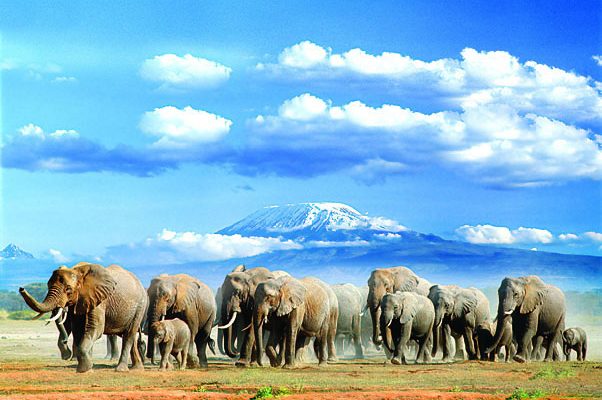
Tarangire assaults the senses from the moment you pass through the gate. The landscape is unlike anything else in Tanzania — a vast, rust-red terrain studded with baobab trees of almost unimaginable antiquity. These ancient giants, some of them over a thousand years old, have trunks as wide as houses, their swollen, wrinkled forms rising from the earth like great grey monuments. In the dry season, when every other water source has evaporated across hundreds of kilometres, the Tarangire River becomes a lifeline — and every creature in the ecosystem knows it. The river banks are extraordinary: elephant herds of fifty, a hundred, two hundred strong moving down to drink in the late afternoon, raising red dust as they come, calves scrambling to keep up with their mothers, bulls jousting lightly at the water’s edge. The noise and the smell and the sheer scale of it is overwhelming. Tarangire also has something the other northern parks lack — a wildness, a rawness, a sense that you are deep in Africa and far from anything safe or familiar. The herds of fringe-eared oryx stand like heraldic creatures in the dry grassland. Vast flocks of red-and-yellow barbets call from the baobab branches. And in the evening, with the sun sinking through the acacia canopy and the Tarangire River glowing gold below, the park takes on a quality of light that painters have tried to capture for centuries and never quite managed.
LAKE MANYARA NATIONAL PARK — The Park of Wonders
Lake Manyara is a park that rewards patience and rewards it magnificently. It occupies a narrow strip of land between the sheer face of the Great Rift Valley escarpment — which rises 600 metres above the valley floor in walls of ancient layered rock — and the alkaline expanse of the lake itself, which stretches south as far as the eye can see. You enter through one of East Africa’s finest groundwater forests, where ancient mahogany and fig trees form a ceiling so dense that midday feels like dusk. The air is thick and green and cool. Elephant families move through the shadows, pausing to strip bark from trees or standing motionless, ears fanned, watching you with ancient eyes that seem to contain something close to judgement. Baboon troops the size of small armies patrol the forest floor. Blue monkeys cascade through the canopy. Hippos wallow in dark forest pools, their pink eyes watching warily. Then the forest opens suddenly onto the lakeshore — and the scale changes completely. Tens of thousands of flamingos can line the shallows in a pink haze that stretches for kilometres. Yellow-billed storks and African spoonbills wade in the shallows. And somewhere in the fever trees near the shore, a lion may be lying along a branch fifteen feet above the ground, a behaviour unique to Manyara, a learned trick that no one has ever fully explained — looking down at the world below with magnificent, drowsy contempt.
NGORONGORO CRATER — The Garden of Eden
To stand on the rim of the Ngorongoro Crater at dawn, before you descend, is to understand for the first time what the word “sublime” was invented to describe. The crater walls drop away beneath your feet in a sheer, forested plunge of 600 metres, and far below, barely visible through the morning mist, the floor of the caldera stretches away — 260 square kilometres of grassland, acacia woodland, swamps, and the silvery shimmer of the soda lake — all contained within the perfect circle of an ancient, collapsed volcano. It is the largest intact caldera on Earth, and it is full of life in a concentration found nowhere else on the planet. Over 25,000 large animals live permanently on the crater floor. They were born here, and unless they choose to climb out — which few do — they will live their entire lives within these walls. The lions are famous: large, dark-maned males descended from a population that was almost wiped out by a fly plague in the 1960s, now recovered and magnificent. The black rhinos are fewer — perhaps a dozen — but each sighting is a moment of pure, almost painful privilege, watching an animal that has walked this Earth for millions of years move slowly across the plain, prehistorically armoured and alone. Wildebeest graze in their thousands. Zebra herds flow like water across the grassland. Hippos pack the central pool so tightly they seem to be one vast grey organism. And the flamingos — always the flamingos — turn the soda lake into something that looks more like a painting than a place. On the drive back up the crater walls in the evening, you will look back down at this world within a world and feel, quite involuntarily, an emotion that is somewhere between gratitude and grief — gratitude that it exists, and a grief you cannot quite name at the thought of ever having to leave it.
SERENGETI NATIONAL PARK — The Eternal Plain
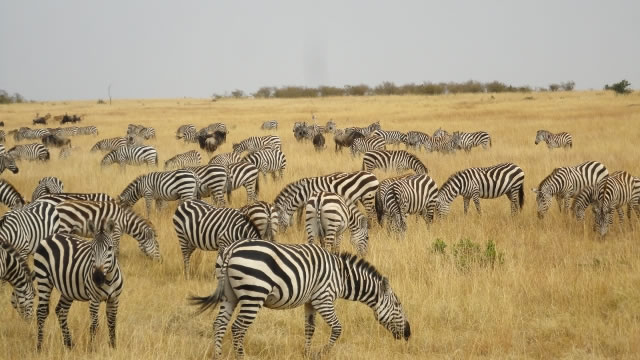
The Serengeti is not a place. It is a state of being. When you first cross into it — the land opening up ahead of you without boundary or fence or limit, the sky suddenly twice as large as it was before, the grass stretching away in every direction to a horizon that is not a wall but a promise — something happens inside you that cannot be undone. The Maasai named it Siringet: the place where the land runs on forever. And it does. Fourteen thousand square kilometres of open savanna, ancient granite kopjes erupting from the plains like the bones of the earth, yellow acacia woodland, and the great rivers — the Grumeti, the Mara — that cut through the landscape in dark, crocodile-filled ribbons. The Serengeti is above all the stage for the Great Migration — the largest movement of land mammals on Earth. One and a half million wildebeest, accompanied by 200,000 zebra and 350,000 Thomson’s gazelle, moving in a vast, perpetual circle across the ecosystem, following the rains, following the grass, following an instinct so ancient it predates human memory. To witness the river crossings — when thousands of wildebeest hurl themselves into the Mara River where enormous Nile crocodiles wait with prehistoric patience — is to watch life and death in their most naked, unmediated form. But even without the Migration, the Serengeti delivers. The central Seronera Valley is the predator capital of Africa. Leopards lie along the branches of sausage trees, their spotted coats perfectly mimicking the dappled light. Cheetah mothers teach their cubs to hunt on the open plains, their accelerations reaching 110 kilometres per hour in seconds — the fastest thing on four legs, burning brief and brilliant. Lion prides of twenty, thirty strong sprawl across the kopjes at sunset, the males roaring in the dusk until the sound rolls across the plain and seems to shake the grass itself. And in the morning — always the morning, always the first light — the Serengeti reveals its truest self: a golden world where animals move through mist and early sun like creatures from a dream, and the sky above goes from black to purple to the most extraordinary burning orange, and you sit on the roof of the Land Cruiser with the engine off and the silence so complete you can hear your own heartbeat, and you understand, finally and completely, why people come to this place once and spend the rest of their lives trying to find their way back.
3 Days Akagera National Park Wildlife Safari
4 Days Zambia-Livingstone Explorer
5 Days Northern Parks Extension
6 Days South Sudan Tour (General)
7-Day One Week Budget Tour in the Splendid Rwanda
8 Days Discover Rwanda Gorillas, Chimps, Dian Fossey Tour (Exclusively Private)
9 Days Safari Vacation (Migration Focus)
10 Day Ultimate Uganda Safari
Kafue NP South to North – 11 Days / 10 Nights
12 Days Best Safari in Tanzania


 Email us bookings@twijaafrica.com
 Call us +256 777 559835