Duration: 3 Days / 2 Nights
3-Day Sossusvlei Amazing Red Dunes — Private Guided Lodge Safari, Namibia
The most visually dramatic landscape in Africa — possibly on earth — where dunes half a billion years in the making rise 300 metres from ancient clay pans in colours that shift from burnt orange to deep crimson with every change of light.
Sossusvlei — Understanding the Landscape
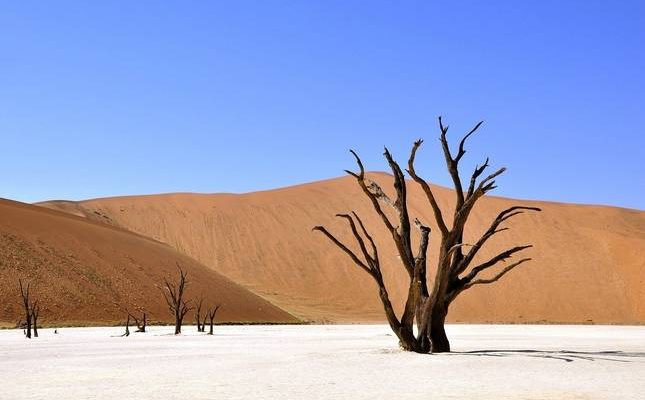
Before the itinerary begins, the landscape itself demands explanation, because Sossusvlei is not simply a collection of large sand dunes. It is one of the oldest, driest, and most geologically extraordinary environments on the planet. The Namib Desert — from which Namibia takes its name — is the oldest desert on earth, estimated at between 55 and 80 million years old, and the dunes of the Sossusvlei area within the Namib-Naukluft National Park are among its most spectacular expressions. The sand itself originated hundreds of kilometres inland, carried by the Orange River to the Atlantic coast, then driven northward by longshore currents and pushed inland by the powerful prevailing winds — a journey of millions of years that has deposited and sculpted these dunes into their current extraordinary forms. The red colour — which deepens with age and oxidation — tells you that the sand in the highest dunes is the oldest, the iron in the quartz grains having oxidised over millennia into the deep burnt orange and crimson that makes Sossusvlei photographs look impossibly oversaturated even when completely unedited. The dead trees of Deadvlei — white camelthorn skeletons standing in a white clay pan surrounded by red dunes, preserved by the extreme aridity for over 700 years — are perhaps the single most photographed landscape in Africa. Standing among them in the early morning light is an experience that belongs in a different category from ordinary travel.
The Private Guided Lodge Experience
This itinerary is built around private guided access — a dedicated guide and vehicle for the duration, lodge accommodation of genuine quality within or immediately adjacent to the park, and the flexibility that private guiding allows in terms of timing, pacing, and depth of engagement with the landscape. The difference between a private guided Sossusvlei experience and a self-drive visit is the difference between reading a book and having its author explain it to you in the places it describes. The guides who work this landscape — many of them with decades of experience reading its moods, its light, its wildlife, and its geology — transform what could be a series of impressive photographs into a genuine understanding of one of earth’s most extraordinary places. Lodges of the calibre appropriate for this itinerary — &Beyond Sossusvlei Under Canvas, Little Kulala, Kulala Desert Lodge, or Sossusvlei Desert Lodge — sit either within the Kulala Wilderness Reserve adjacent to the national park or as close to the park gate as regulations permit, with private access gates that allow guests to enter the park before the public gate opens at sunrise — a logistical advantage whose value, in terms of light and solitude, cannot be overstated.
Day 1 — Arrival & First Encounter with the Dunes
Arrival — By Air into the Desert The most appropriate arrival into Sossusvlei is by light aircraft from Windhoek’s Eros Airport or from another Namibian lodge — a flight of roughly one hour that transforms the abstract knowledge of the Namib’s scale into a physical reality as the desert spreads below in every direction to every horizon. From the air, the dune sea of the Namib is genuinely oceanic — wave after wave of sand ridges in every shade of orange and red, the linear star dunes casting sharp shadows, the occasional white clay pan gleaming like a mirror in the aridity. The airstrip at Kulala or Sossus serves the main lodges, and the transition from aircraft steps to open vehicle is immediate — the desert air, the silence, the scale, all arriving at once as the propellers slow and the engine sound fades into the vast quiet of the Namib.
Afternoon — Elim Dune & Desert Orientation Rather than immediately assaulting the major dunes on the first afternoon — a tactical error that sacrifices the best morning light on the highest dunes — day one’s afternoon is devoted to Elim Dune, a large but less visited dune accessible directly from the Kulala Wilderness Reserve without entering the national park. Elim Dune is an ideal orientation to the landscape — high enough to require genuine effort to climb, rewarding enough at the summit to make that effort feel worthwhile, and positioned perfectly for afternoon light that illuminates the dune face in deep warm tones while casting the slip face into dramatic shadow. The guide uses the climb and the summit views to explain the dune’s formation — how the prevailing southwesterly winds build the dune’s windward face in a long gentle slope while the lee side falls away sharply in the slip face angle of repose, how the dune’s crest moves with every wind event, how the entire dune has been migrating slowly across the desert floor for thousands of years. Understanding dune mechanics transforms every subsequent dune encounter from aesthetic experience into geological narrative.
Sundowner — Desert Light & Silence The Namib sundowner — cold drink in hand, sitting on a dune crest or a rocky outcrop above the desert floor as the sun drops toward the western horizon — is among the finest versions of that African ritual available anywhere. The light at Sossusvlei in the last hour before sunset is extraordinary in a specific, unrepeatable way — the dunes shift through their full colour range in reverse as the shadows lengthen, from the bright orange of midday through amber and gold and finally into a deep crimson that makes the landscape look briefly on fire before the colours desaturate into the blue-grey of dusk. The silence that comes with the light is its equal partner. The Namib is one of the quietest places on earth — no wind in the still evening air, no insects, no distant traffic, no aircraft, nothing. Just the occasional soft sound of sand grains settling on the dune face, and the vast indifferent quiet of the oldest desert on the planet.
Evening — Lodge Dinner Under Desert Stars The lodges serving this itinerary are unanimous in one respect — the night sky above the Namib is among the clearest and most spectacular on earth. Namibia has the lowest light pollution of any country in Africa, and the Namib’s clean dry air and flat horizons create viewing conditions that amateur astronomers travel specifically to experience. Dinner under the stars — whether a formal lodge dining experience or a more intimate private setup in the dunes — is followed by stargazing with the guide or a dedicated astronomer on staff at the better properties. The Milky Way at Sossusvlei is not a faint smear on the horizon but a complete, overwhelming, three-dimensional presence that fills the sky from horizon to horizon. The Southern Cross. The Magellanic Clouds — satellite galaxies of the Milky Way visible to the naked eye only from the Southern Hemisphere. The sheer density of stars in a sky uncontaminated by any artificial light. It is the kind of sky that makes people feel simultaneously very small and very fortunate.
Day 2 — Big Daddy, Deadvlei & Hidden Vlei
Pre-Dawn — Into the Park Before the Public The private gate access that lodge guests enjoy is the single most valuable logistical advantage of the guided lodge experience, and it is most valuable on the morning of the big dune climbs. The public gate at Sesriem opens at sunrise. Lodge guests with private access can enter the park up to an hour before sunrise, driving the 65-kilometre road to the Sossusvlei parking area in darkness and arriving at the dune base as the first light begins to differentiate sky from dune crest — the precise moment when the landscape is at its most theatrical and the solitude is at its most complete. By the time the first public vehicles arrive at the parking area, lodge guests are already at altitude on the dune face, watching the light arrive.
Sunrise — Climbing Big Daddy Big Daddy is the highest dune in the Sossusvlei area — approximately 325 metres from base to crest — and climbing it at sunrise is the defining physical experience of any Sossusvlei visit. The climb takes between 45 minutes and an hour and a half depending on fitness and pace, the soft sand of the windward face requiring a particular technique — stepping into the firmer sand at the very crest of the dune’s edge rather than the soft sliding sand of the open face — that the guide demonstrates and that takes a few minutes to learn but transforms the effort required. The physical challenge is real and not to be underestimated, particularly in the heat that builds quickly after sunrise. But the summit of Big Daddy at first light is a reward entirely proportionate to the effort. The view from the crest extends across the entire Sossusvlei basin — the white pan of Deadvlei directly below, ringed by dunes in every direction, the Dead Vlei’s ancient tree skeletons visible as dark marks against the white clay — and in every other direction the Namib dune sea rolling to the horizon without interruption. The descent from Big Daddy is the most purely enjoyable element of the entire climb — running, leaping, sliding down the steep slip face in enormous bounding strides, the sand soft enough to be entirely forgiving, covering in three exhilarating minutes the altitude that took an hour to gain.
Mid-Morning — Deadvlei The descent from Big Daddy deposits you directly at the edge of Deadvlei — the ancient clay pan that is simultaneously the most photographed and the most genuinely strange landscape in Namibia. The pan was once a floodplain fed by the Tsauchab River, supporting a woodland of camelthorn acacia trees. Around 900 years ago the river changed course, blocked by encroaching dunes, and the trees died as the water source disappeared. The extreme aridity of the Namib — annual rainfall often below 10 millimetres — preserved the dead trees rather than decomposing them, and they stand today exactly as they died, bleached white by centuries of sun, their dead forms casting stark shadows on the white clay against the backdrop of orange-red dunes and an impossibly blue Namibian sky. The visual composition of Deadvlei — white ground, white trees, red dunes, blue sky — is so extreme in its colour contrast and so geometrically dramatic in its forms that it consistently defeats photography’s ability to capture it accurately. Being physically present in the pan, moving among the ancient trees, sitting quietly in the silence of a landscape that has been dead for seven centuries — is an experience of a completely different order from any image of it.
Late Morning — Hidden Vlei & Geology Walk While the crowds that arrived at the public gate concentrate at Deadvlei and the Sossusvlei pan, the private guided experience allows access to Hidden Vlei — a smaller, completely unmarked clay pan reached by a 45-minute walk through an inter-dune corridor that most visitors never find. The walk to Hidden Vlei is itself among the best things about the morning — the inter-dune corridor is a completely different environment from the open dune faces, sheltered and intimate, with its own microclimate supporting surprising plant and animal life. The guide reads the desert here in extraordinary detail — the tracks of a sidewinding adder from the previous night, the excavations of a tok-tokkie beetle collecting moisture, the precise wind-sculpted ripple patterns on the corridor floor that indicate prevailing wind direction, the surprisingly diverse plant community of dollar bush and dollar plant and Namib grasses that have evolved specific water-capture mechanisms for surviving in a desert that measures annual rainfall in single-digit millimetres. Hidden Vlei itself is smaller and less dramatic than Deadvlei but completely unmarked by human presence — the sense of genuine discovery it provides is disproportionate to its physical scale.
Midday — Return to Lodge & Pool The Namib midday is genuinely inhospitable — temperatures in the pan regularly reach 45 to 50 degrees Celsius between November and March — and the lodges are designed with this reality in mind. The return to the lodge for lunch and the pool hours of midday is not a concession but a necessity, and the better properties make these hours as pleasurable as the dawn activities. Lunch in the shade of a reed-and-canvas structure with cold water and local food after a morning of physical intensity in the desert has a specific and deeply satisfying quality. Sleep is not only acceptable in the midday hours but actively encouraged — the afternoon activities begin late enough that a genuine rest is possible.
Late Afternoon — Sesriem Canyon As the heat begins to relent in the late afternoon, the itinerary moves to Sesriem Canyon — a narrow gorge cut by the Tsauchab River through 30 metres of consolidated Namib gravel deposits over millions of years, located just outside the park gate near the lodge. The canyon is geologically fascinating — the exposed rock faces reveal layers of ancient gravel deposits, each layer representing a different period of Namib geological history, the whole sequence covering millions of years of desert formation compressed into a cliff face you can read with your hands. The canyon holds water for longer than the surrounding desert after the rare rainfall events, and the plant and animal life concentrated within it — fig trees finding root in the rock cracks, rock hyrax colonies in the boulders, various raptors nesting in the cliff faces — creates an unexpected oasis effect in miniature. Walking the canyon floor in late afternoon light, the walls narrowing in places to a metre or two, the sky a thin blue strip above, is a completely different Namib experience from the open dune landscape of the morning.
Day 3 — Dune 45, Desert Wildlife & Departure
Pre-Dawn — Dune 45 Sunrise The final morning is devoted to Dune 45 — the most accessible, most photographed, and in many ways most classically beautiful of the Sossusvlei dunes, located 45 kilometres from the Sesriem gate along the main park road. The name is straightforwardly geographical — 45 kilometres from the gate — but the dune itself is anything but ordinary. At roughly 170 metres, it is considerably lower than Big Daddy, making it more accessible to a wider range of visitors, and its position isolated in an open area between flanking dunes gives it a classical star dune shape that photographs with extraordinary clarity. Climbing Dune 45 at dawn — the guide setting a pace that reaches the crest just as the sun breaks the eastern horizon — is the most reliably magnificent sunrise experience in the Namib. The light arrives on the dune crest first, then spreads down the windward face, the shadow retreating across the pan below as the sun rises, the entire process taking perhaps twenty minutes from first light to full sun. In those twenty minutes the dune passes through fifteen different colours, none of which has a precise name in any language.
Morning — Desert Wildlife & Tracking The Namib Desert is far more alive than it appears, and the final morning’s game drive through the Kulala Wilderness Reserve — the private concession adjoining the national park — reveals a surprising diversity of desert-adapted wildlife that the dune focus of the previous days has not addressed. Oryx — the gemsbok — are the Namib’s most iconic large mammal, an animal so perfectly adapted to desert conditions that its body temperature can rise to 45 degrees Celsius without brain damage, a physiological feat made possible by a specialised network of blood vessels that cools arterial blood before it reaches the brain. Springbok bound across the gravel plains in their characteristic stotting leaps. Ostriches stride across the open desert with their peculiar dignified urgency. Smaller desert specialists reward closer attention — the web-footed gecko whose oversized feet spread its weight on loose sand, the Namaqua chameleon that changes colour to regulate body temperature rather than for camouflage, the various tok-tokkie beetles whose fog-basking behaviour — standing on dune crests in morning fog with bodies angled to channel condensed moisture toward their mouths — is one of the most elegant evolutionary solutions to desert water scarcity documented anywhere. The guide tracks and interprets all of this with the fluency of someone who has spent years learning to read a landscape that appears empty to the uninitiated eye.
Late Morning — Departure The final hours before the light aircraft return to Windhoek or onward to another Namibian destination are spent in the particular quality of time that good journeys produce near their end — unhurried, attentive, slightly reluctant. A final coffee on the lodge deck looking at the dunes. A last walk to a high point for a farewell view across the desert. The drive to the airstrip through the landscape that has become, over three days, genuinely familiar — the dune colours, the quality of the light, the silence, the scale — all of it now loaded with experience and memory in a way that the arrival drive was not. The aircraft lifts off and the Namib spreads below again — the same view as the arrival, but completely transformed by everything that happened between.
Practical Notes
Best Season for Sossusvlei divides into two distinct experiences. The dry winter months of May through October offer cooler temperatures — mornings can be genuinely cold, requiring layers — clearer skies, and the most comfortable conditions for dune climbing. The summer months of November through April bring heat of genuine intensity but also the possibility of dramatic thunderstorms that transform the desert with temporary watercourses and explosive wildflower blooms in exceptional rainfall years. Both seasons have their advocates among experienced Namib visitors.
Photography at Sossusvlei rewards the early riser absolutely and without compromise. The difference between the dune colours at 7am and 10am is the difference between a masterpiece and a postcard. Every itinerary element that involves the major dunes is timed accordingly, and the private gate access that lodge guests enjoy is the mechanism that makes that timing consistently achievable.
Physical Preparation for Big Daddy in particular is worth taking seriously. The climb is not technically difficult but it is aerobically demanding, particularly in warm weather, and the altitude gain at soft sand angles is more tiring than an equivalent climb on solid ground. Proper hydration beginning the day before, good footwear, and a realistic assessment of personal fitness will make the difference between an experience remembered with triumph and one remembered with regret.
Combining Sossusvlei with other Namibian destinations — the Skeleton Coast, Damaraland and the desert-adapted elephants, Etosha National Park for big game, or the Fish River Canyon in the south — creates one of Africa’s most complete and diverse safari itineraries, covering landscapes and wildlife experiences available nowhere else on the continent in such concentrated and accessible form.


 Email us bookings@twijaafrica.com
 Call us +256 777 559835