12 DAYS BEST SAFARI IN TANZANIA
ARUSHA — Where the Journey Begins
Arusha arrives like an overture — a city that hums with the particular electricity of a place that knows it sits at the threshold of something immense. Nestled at 1,400 metres between the brooding cone of Mount Meru and the distant, cloud-wrapped crown of Kilimanjaro, it is a city of contrasts so vivid they feel almost theatrical. Maasai warriors in ochre-red shukas negotiate the same pavements as European safari operators and Tanzanian businessmen in sharp suits. The central market is a sensory avalanche — heaps of dried fish and fresh mangoes, the sharp green smell of cardamom, bolts of bright kitenge fabric piled ceiling high, the sound of Swahili bargaining conducted at speed and high volume. In the evenings the restaurants fill with travellers who have just returned from the bush — sunburned, wide-eyed, still processing what they have seen — and travellers who are about to go, restless with anticipation, studying field guides over their nyama choma and cold Kilimanjaro beers. Arusha is the last outpost of the ordinary world. From here, everything changes.
ARUSHA NATIONAL PARK — The Forgotten Masterpiece
Most people pass through Arusha National Park on their way to somewhere else, which means most people miss one of Tanzania’s most quietly spectacular wild places. It is small — barely 552 square kilometres — but it is ferociously alive, compressing three entirely distinct ecosystems into one compact, extraordinary landscape. You enter through a corridor of ancient fig trees so enormous their canopies blot out the sky, their roots erupting from the red earth in great tangled arches. Black-and-white colobus monkeys hang from the branches like living ornaments, their long white capes drifting in the forest breeze. The forest opens onto the Ngurdoto Crater — a miniature caldera whose steep walls drop away into a swampy floor that no human is permitted to enter, a wilderness within a wilderness, watched over in permanent, pristine silence. Then the Momela Lakes appear — a sequence of shallow, alkaline waters tinted different colours by different algae, their shores pink with flamingos, their surfaces broken by the angular shapes of hippos and the elegant wading of African spoonbills. And on those rare, perfect mornings when the clouds part simultaneously in two directions, both Mount Meru and Kilimanjaro are visible at once — two great volcanoes standing sentinel above the landscape, an image so grand and improbable it looks like something painted rather than real.
MOUNT KILIMANJARO — Africa’s Greatest Monument
Kilimanjaro does not announce itself gradually the way most mountains do. It simply appears — rising from the flat savanna plains without warning or foothills in a single, vertiginous sweep of 5,895 metres, its glaciated summit floating above the clouds like something that belongs to a different atmosphere entirely. It is the highest free-standing mountain on Earth, and its presence dominates the northern Tanzanian landscape with a quiet, overwhelming authority that no photograph has ever truly captured. The lower slopes are wrapped in some of East Africa’s most pristine rainforest — a dark, dripping, cathedral-green world where cape buffalo move like shadows between the trees and the calls of Hartlaub’s turacos echo through the mist. Higher up, the forest gives way to heathland studded with giant lobelias and groundsels — alien, surreal plants that look as though they were designed for another planet — and then to the high alpine desert, and finally to the glaciers themselves, ancient rivers of ice that have crowned this mountain for eleven thousand years and are now, heartbreakingly, retreating. Even if you never set a boot on its slopes, to spend a morning in the presence of Kilimanjaro — watching the clouds build and dissolve around its summit, feeling the mountain’s immensity as a physical sensation in the chest — is to understand something about the scale of the natural world that no words can adequately prepare you for.
TARANGIRE NATIONAL PARK — The Realm of the Ancients
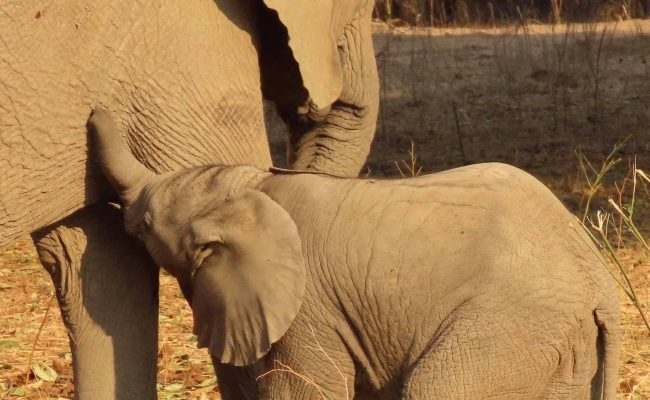
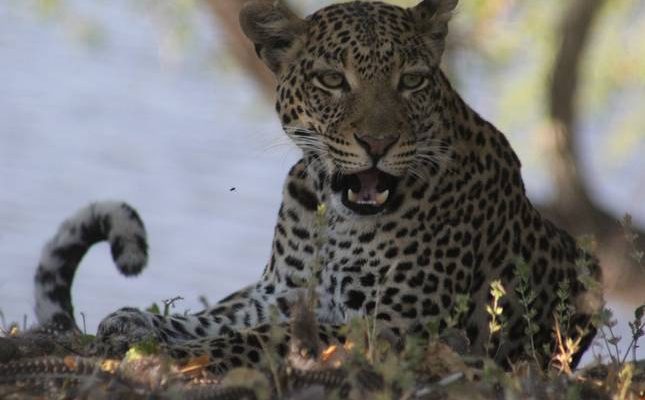
Tarangire is the Tanzania that exists before the crowds, before the famous names, before the postcards — raw and ancient and completely, unapologetically itself. The landscape hits you immediately with a quality that is almost hallucinatory: the red, cracked earth; the immense sky pressing down from above; and everywhere, rising from the ground like monuments to geological time, the baobab trees. Some of these trees are over a thousand years old. Their trunks, grotesquely swollen and silver-grey, are wide enough to shelter a family inside, and they stand across the landscape in their hundreds — solitary, magnificent, impossibly ancient — as though the park were a museum of living sculpture. In the dry season, the Tarangire River is the only water for hundreds of kilometres in every direction, and the animals know it. The elephant herds that gather here are the largest in northern Tanzania — sometimes two hundred strong, moving to the water in the amber light of late afternoon with a slow, inevitable grandeur that makes your throat tighten. Massive bulls with tusks that brush the ground. Mothers with newborns so young their skin is still pink and wrinkled. Young males sparring at the river’s edge while the older bulls drink in heavy, dignified silence. The river banks are also home to enormous herds of buffalo, families of warthog trotting with their tails raised like little flags, and leopards that lie in the yellow fever trees above the water, watching everything below with the supreme indifference of those who have no natural enemies. Tarangire delivers a kind of wild, unfiltered Africa that stays in the bloodstream long after everything else has faded.
LAKE MANYARA NATIONAL PARK — The Rift Valley’s Secret
Lake Manyara is a park of layers — literal and metaphorical — and the more time you spend inside it, the more it reveals. The Great Rift Valley escarpment forms its western wall, rising six hundred metres in sheer, ancient rock that was torn apart by tectonic forces three million years ago, and the drama of that geological violence is still palpable in the landscape today. Below the escarpment, pressed between the cliff face and the alkaline lake, a ribbon of habitat runs for fifty kilometres — groundwater forest, acacia woodland, open floodplains, and the lake itself — each zone so different from the last that driving through them feels like moving between separate worlds. The forest at the park’s entrance is among the finest in East Africa — dense and green and cool, threaded with the sound of running water and alive with the movement of animals in the shadows. Elephant families drift between the trees with extraordinary silence for creatures of their size. Enormous troops of olive baboons patrol the forest floor like armies. Then the trees thin and the lake appears — vast, alkaline, and alive with birds in numbers that defy comprehension. Hundreds of thousands of flamingos can turn the shallow margins of the lake into a shimmering pink haze that stretches for kilometres in both directions. Yellow-billed storks fish in the shallows. African fish eagles call from the dead trees at the water’s edge with a cry so wild and piercing it seems to contain the entire soul of Africa in a single sound. And somewhere in the fever trees, in the dappled light above the floodplain, a lion may be lying along a branch ten feet off the ground — a behaviour unique to Manyara, inexplicable and unforgettable, a reminder that the natural world will always surprise you precisely when you think you have begun to understand it.
NGORONGORO CRATER — The World That Time Forgot
You hear the Ngorongoro Crater before you see it — or rather, you feel it, a kind of atmospheric pressure change as the road climbs through the dense, cloud-forest-draped rim and the world outside the windows becomes wreathed in mist and silence. Then the vehicle stops, and you walk to the edge, and the crater floor appears six hundred metres below — and your mind simply stops working for a moment, overwhelmed by a scale and beauty it was not designed to process in a single instant. The caldera is 260 square kilometres of enclosed Eden: open grassland, acacia woodland, the dark glitter of the hippo pool, and the silver-white sheet of the soda lake, all contained within a perfect circle of volcanic walls that rise on every side like the walls of a colosseum built by the earth itself. Over 25,000 large animals live permanently on the crater floor, in a concentration of wildlife that has no parallel anywhere on the planet. The lions here are famous — large-maned, magnificent males descended from a population that nearly died out in the 1960s, now fully recovered and utterly dominant, lounging across the grassland with the proprietorial ease of landlords who know every centimetre of their estate. The black rhinos are rarer and more precious — a small population of perhaps a dozen individuals who move across the crater floor like living relics of a deeper time, prehistoric and solitary and heartbreakingly rare. The hippo pool at the crater’s centre is a spectacle of compressed biological chaos — dozens of enormous bodies packed so tightly together that the water is barely visible between them, their rumbling and snorting and yawning filling the air with a sound that is simultaneously comic and deeply, primally unsettling. To descend into the Ngorongoro Crater is to step out of the modern world entirely, into a place that operates according to laws older than human consciousness — and to climb back out in the evening, looking down one final time at the mist gathering on the crater floor below, is one of the most quietly devastating farewells you will ever make.
SERENGETI NATIONAL PARK — The Infinite Plain
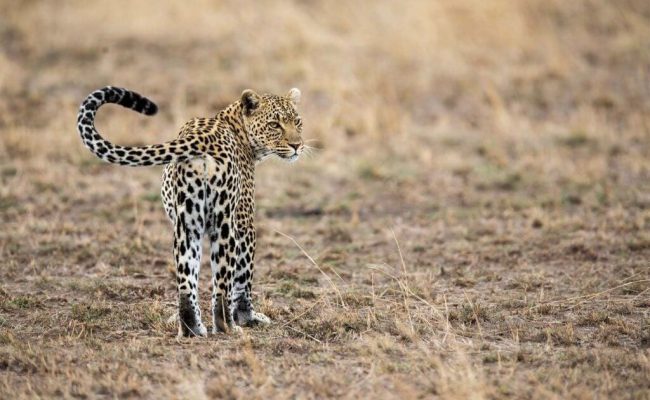
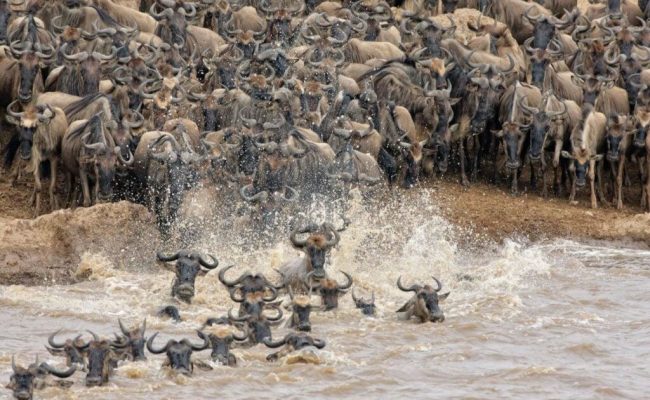
The Serengeti is not merely a national park. It is a concept, a mythology, an idea of Africa so fundamental and so ancient that it seems to exist in the human imagination before the human being who encounters it has ever seen it. And then you cross the boundary — the acacia trees thinning, the land opening, the sky expanding in every direction until it occupies not just the view ahead but the entire periphery of your vision — and you understand that no idea, no photograph, no film, no description has come anywhere near the reality. The Maasai named it Siringet — the place where the land runs on forever — and it does. Fourteen thousand square kilometres of open savanna stretching to horizons that seem to curve with the earth itself, ancient granite kopjes erupting from the plains like the exposed skeleton of the continent, and through it all the great rivers — the Grumeti, the Mara — threading their dark, crocodile-thick courses through the gold and green of the grass. The Great Migration is the Serengeti’s most famous act — 1.5 million wildebeest and 200,000 zebra and 350,000 gazelle moving in a perpetual, instinct-driven circle across the ecosystem, following the rains, following the grass, following something so ancient it has no name. The river crossings, when they come, are among the most violent and visceral spectacles in the natural world — thousands of animals hurling themselves into churning brown water where Nile crocodiles of four and five metres wait with a patience refined over sixty-five million years, the chaos and the noise and the desperation and the survival all happening simultaneously in front of you, raw and unmediated and completely beyond the reach of sentiment. But the Serengeti is magnificent even in its quieter registers. The central Seronera Valley delivers predator sightings of a quality found nowhere else on Earth — leopards draped in the fork of a sausage tree, their amber eyes half-closed against the afternoon heat; cheetah mothers on termite mounds scanning the plain with a focus so intense it seems to reshape the air around them; lion prides of thirty spread across a kopje at sunset, the great males roaring as the light fails, their sound rolling across the grass in waves you feel in your sternum before you hear with your ears. And the mornings — always the mornings — when the Serengeti sky moves through its daily miracle of black to purple to rose to gold, and the silhouettes of acacia trees cut against the burning horizon, and the engine is switched off and the silence arrives like a physical presence, and somewhere out in the grass a lion walks unhurriedly through the mist, indifferent to your watching, magnificent in its absolute self-sufficiency — in those mornings, which you will remember with a clarity that does not fade, the Serengeti gives you something that the rest of the world, for all its noise and speed and complication, simply cannot.
ZANZIBAR — The Spice Island Finale
After the dust and the dawn drives and the vast, wild openness of the mainland, Zanzibar arrives like a dream of another kind entirely. The dhow that carries you across the channel from Dar es Salaam moves through water of a blue so saturated it seems artificial — turquoise giving way to cobalt giving way to the deep indigo of the open Indian Ocean — and then the island appears, low and green on the horizon, its ancient coral-stone buildings rising from the shore. Stone Town, the old Arab quarter of Zanzibar City, is a UNESCO World Heritage Site and one of the most atmospheric urban environments in the world — a labyrinth of narrow, shadow-cool alleys that twist and turn between buildings five and six centuries old, their carved wooden doors studded with brass and inlaid with geometric patterns of extraordinary intricacy, each one a small masterpiece of Swahili-Arab craftsmanship. The smell of the place is part of its soul: cloves and cinnamon and cardamom drifting from the spice market, the salt-and-seaweed breath of the harbour, the charcoal smoke of street food being grilled at the Forodhani night market where vendors lay out grilled lobster and octopus and sugarcane juice in the warm salt air. Beyond Stone Town, the island unfolds in a succession of beaches that rank among the finest on Earth — Nungwi in the north, where the sand is powder-white and the dhows are pulled up on the beach at low tide; Kendwa, where the water is so clear and warm and still it is difficult to locate the precise moment it begins and the sky ends; Paje on the east coast, where the reef drops away into deep water and the snorkelling reveals a world of coral gardens and hawksbill turtles and clouds of electric-blue fish that move through the water like living light. After twelve days of early mornings and big skies and the magnificent, exhausting intensity of the wild, Zanzibar asks nothing of you except to lie down, feel the warm Indian Ocean between your fingers, and let the extraordinary journey you have just completed settle slowly and permanently into the deepest part of your memory, where it will remain, vivid and irreplaceable, for the rest of your life.
10 Day Ultimate Uganda Safari
Kafue NP South to North – 11 Days / 10 Nights
12 Days Honeymoon Tanzania + Zanzibar
9 Days Safari – Wildebeest Migration & Mara River Crossing
8 Days Tanzania Holiday
7 Days Masai Mara → Lake Nakuru → Amboseli Safari – 7 Days / 6 Nights
6 Days South Sudan Tour (General)
5 Days Discover Rwanda & Gorilla Trekking Adventure
4 Days Zambia-Livingstone Explorer
3 Days – Lochinvar NP Bird-Watching Excursion
2 Day Jinja Adventure Tour


 Email us bookings@twijaafrica.com
 Call us +256 777 559835