3-Day Lochinvar National Park Bird-Watching Excursion — Zambia
One of Africa’s great ornithological secrets — a vast Kafue Flats wetland ecosystem supporting six hundred species and one of the continent’s most spectacular concentrations of waterbirds, visited by a fraction of the birders who would make it a pilgrimage destination if they knew it existed.
Lochinvar National Park — The Place & Its Significance
Lochinvar National Park sits on the southern bank of the Kafue Flats in Zambia’s Southern Province — a vast seasonal floodplain of the Kafue River that expands dramatically during the wet season and contracts to a network of permanent lakes, channels, and marshes during the dry months, creating a dynamic wetland ecosystem of extraordinary ecological productivity and ornithological richness. The park covers 428 square kilometres of varied habitat — open floodplain grassland, seasonal and permanent wetlands, acacia woodland on the higher ground, and the remarkable Chunga Lagoon at the park’s heart, a permanent body of water that concentrates wildlife and waterbirds in numbers that can genuinely take the breath away. Lochinvar was designated a Ramsar Wetland of International Importance in 1971 — one of the first sites on the African continent to receive this recognition — a designation that reflects the global significance of the Kafue Flats ecosystem for migratory waterbirds whose flyways connect this southern African wetland with breeding grounds in Europe, Asia, and the Arctic. Over 420 species have been recorded within the park boundaries, and the broader Kafue Flats system supporting the park’s bird community hosts over 600 species in total — a figure that makes the area one of the most species-rich birding destinations in southern Africa and one of the least visited relative to its ornithological importance. The Kafue Flats are also home to the largest remaining population of the Kafue lechwe — a specialised floodplain antelope whose splayed hooves and powerful hindquarters are adaptations for moving through the shallow inundated grasslands that define the flats’ character — and the ecological relationship between the lechwe herds and the floodplain bird community is one of the most fascinating and least studied wildlife interactions in Zambia.
Day 1 — Arrival & Afternoon Wetland Introduction
Morning — Travel to Lochinvar The journey to Lochinvar from Lusaka covers approximately 180 kilometres southwest via the Monze road, passing through the characteristic plateau landscape of Zambia’s Southern Province — flat to gently rolling, dominated by miombo and mixed woodland, the occasional granite kopje breaking the horizon, the roadside markets selling the remarkable variety of produce that Zambia’s agricultural heartland generates. The road to Monze and then northwest to the park entrance crosses the escarpment that separates the Zambian plateau from the Kafue Flats — a descent of several hundred metres that is accompanied by a dramatic opening of the landscape, the flat expanse of the flats suddenly visible ahead in all its extraordinary horizontal vastness, the sky enormous above it, the distant glimmer of water on the floodplain catching the late morning light. The transition from plateau woodland to floodplain is abrupt and visually stunning — one of those geographical transitions that makes the body understand landscape change before the mind has fully processed it. The park entrance and ranger station at Lochinvar are straightforward, the formalities quick, and the first proper birding begins almost immediately on the track inside the boundary.
Afternoon — Chunga Lagoon First Visit Chunga Lagoon — the permanent lake at the heart of Lochinvar’s wetland system — is the ornithological centrepiece of the park and the destination toward which the afternoon’s first game drive is directed with purposeful speed. The approach to the lagoon through the open floodplain grassland is itself excellent birding — wattled crane, one of Africa’s most endangered large birds, stalks the short grass with its distinctive bobbing gait, its red facial wattles and slate-grey plumage making it one of the most elegant birds on the flats. Crowned crane — equally large, equally beautiful, with its extraordinary golden crown of stiff feathers — moves in pairs and small groups across the open grassland, the contrast between its grey body, red and white facial pattern, and spectacular crown creating an impression of theatrical excess that evolution has somehow produced entirely without irony. Intermediate and great egrets stand motionless at the lagoon edge. Yellow-billed stork — one of the most abundant and visually striking waterbirds of the Kafue Flats — wades through the shallows with its partially open bill, using tactile rather than visual hunting to detect fish in the murky water, its pink-washed white plumage and bright yellow bill catching the afternoon light with considerable impact. The first view of Chunga Lagoon from the elevated bank above the water — the expanse of open water dotted with thousands of waterbirds, the papyrus margins thick with reed warblers and bishops, the open water alive with surface-feeding ducks and diving grebes — is one of those ornithological moments that experienced birders travel specifically to experience and that first-time visitors to Lochinvar consistently describe as one of the most impressive single wildlife sightings of their African experience.
Shoebill — The Great Prize Any honest account of Lochinvar’s birding must address the shoebill immediately and directly, because for a significant proportion of the birders who make the journey to the Kafue Flats, the shoebill is the primary motivation. The shoebill — Balaeniceps rex, King Whale-head — is one of Africa’s most extraordinary birds, a massive grey heron-like species standing 1.2 metres tall with a bill of such disproportionate size and such peculiar shape — wide, deep, hooked, resembling a Dutch clog as much as anything in the ornithological vocabulary — that it appears to belong to a different evolutionary era from the birds around it. It does, in a sense — the shoebill’s closest relatives are the pelicans and the hamerkop, and its lineage is ancient enough to give the bird a genuinely prehistoric quality that photographs convey but physical presence magnifies enormously. The shoebill hunts lungfish in the papyrus swamps and shallow floodplain channels — standing motionless for extended periods before lunging with terrifying speed and precision, the massive bill closing on fish that would escape any other heron. The Kafue Flats support one of the most accessible shoebill populations in Africa — the species is also found in Uganda’s Murchison Falls wetlands and in South Sudan’s Sudd — and the guides at Lochinvar know the specific channels and papyrus patches where individuals are regularly encountered. A shoebill sighting is never guaranteed, but the probability at Lochinvar in appropriate season, with experienced guidance, is high enough that the species can reasonably be described as a target rather than a hope.
Evening — Floodplain Sunset The Kafue Flats sunset is one of the great African natural spectacles that receives almost no international recognition simply because so few visitors are present to witness it. The flat topography and enormous sky of the floodplain create conditions for sunset that have no equivalent in the highland or woodland landscapes that most southern African safaris occupy — the light spreading horizontally across the water and grassland without obstruction, the colours reflected simultaneously in the sky above and the lagoon below, the silhouettes of wattled cranes and yellow-billed storks moving across the orange western horizon in their thousands. Camp at Lochinvar — basic but functional national parks accommodation at the main camp, or better-appointed private camping arrangements made through specialist operators — receives the evening with the particular simplicity of a place that has not been developed for mass tourism, its facilities honest and its surroundings extraordinary.
Day 2 — Full Day Ornithological Immersion
Pre-Dawn — Dawn Chorus & Early Activity The Lochinvar dawn begins before sunrise with a soundscape of such complexity and volume that it requires a moment of simple listening before any attempt at identification is made. The papyrus beds erupt with the calls of warblers, bishops, and whydahs beginning their territorial declarations. Wattled cranes call from the open floodplain with their extraordinary bugling voices that carry for kilometres across the flat landscape. African fish eagle announces the day from its perch above the lagoon. And from the papyrus channels, the deeper, stranger calls of the wetland specialists — bitterns, rail species, and the various secretive birds of the dense reed beds — add bass notes to the treble cacophony of the open floodplain species. Pre-dawn birding at the lagoon edge — standing in the growing light as the bird community becomes progressively more visible and the list builds with a speed that experienced birders find actively exciting — is the finest single birding hour that Lochinvar offers, and the guide who has worked the flats across many seasons knows precisely where to position the group for maximum species encounter in this crucial window.
Morning — Systematic Lagoon Circuit The morning’s main birding session is a systematic circuit of Chunga Lagoon’s accessible margins — moving slowly around the water’s edge by vehicle and on foot, working each habitat zone methodically and building the day’s species list with the careful thoroughness that separates serious birding from casual wildlife watching. The open water holds a comprehensive duck community during the wet season and its aftermath — fulvous whistling duck, white-faced whistling duck, knob-billed duck, African pygmy goose — the last a jewel of a bird, barely larger than a starling, the male’s metallic green head and white facial patch entirely disproportionate in their beauty to the bird’s miniature size. African darter and reed cormorant compete for the same elevated perches above the water, their different postures — the darter’s snake-necked, aristocratic, upright; the cormorant’s hunched and pragmatic — making identification straightforward even at distance. The papyrus margins deserve dedicated attention — slow, patient searching with binoculars into the dense reed stems, guided by calls that the experienced guide identifies and then tracks to their source. Zambian barred warbler, African reed warbler, lesser swamp warbler — the papyrus warbler community is numerically dominated by species that require careful separation and reward the attention they demand with the satisfaction of confident identification rather than uncertain dismissal.
Lechwe Interaction & Floodplain Ecology The Kafue lechwe herds that move across Lochinvar’s floodplain grasslands are not merely a mammal sighting alongside the birding — they are an integral part of the floodplain ecosystem whose relationship with the bird community is ecologically fascinating and visually spectacular. The lechwe’s movement through the shallow inundated grassland disturbs fish and invertebrates from the vegetation, creating a feeding opportunity that yellow-billed storks, herons, and egrets actively exploit by following the herds through the water. This association — large wading birds walking directly alongside or even among the lechwe, picking up the food items disturbed by the antelope’s movement — is one of the Kafue Flats’ most charming and most commonly observed inter-species interactions, and watching it play out across the open floodplain with thousands of lechwe and hundreds of attendant birds creates an impression of ecosystem health and ecological completeness that is increasingly rare anywhere in Africa.
Midday — Woodland Birding & Thermal Raptor Watching The midday hours at Lochinvar shift the birding focus from the wetland to the acacia and mixed woodland that covers the park’s higher ground — a habitat that holds an entirely different bird community from the floodplain species and one that rewards the change of pace that the midday heat naturally encourages. The woodland edge between the open floodplain and the denser acacia is particularly productive — an ecotone where species from both habitats concentrate and where the structural complexity of the vegetation creates nesting and foraging opportunities for a wide variety of species. Long-tailed paradise whydah in breeding plumage — the male’s extraordinary tail feathers extending two to three times the length of his body, the whole extraordinary structure somehow navigated through dense acacia branches with remarkable agility — is one of the most visually arresting of the woodland edge species. Southern carmine bee-eater — perhaps the most spectacularly beautiful of southern Africa’s bee-eater family, its deep crimson body and turquoise crown and tail making it look painted rather than evolved — hunts flying insects from exposed perches or from the backs of large animals and kori bustards, using the larger creatures as mobile observation platforms in a behaviour that is as practically clever as it is visually extraordinary. The thermal columns that build over the floodplain in the midday heat carry raptors — African marsh harrier quartering the reed beds, western osprey circling above the lagoon, and the various migrant raptors that pass through or overwinter on the Kafue Flats — to heights where they are visible simultaneously in numbers that make scanning the sky a worthwhile dedicated activity.
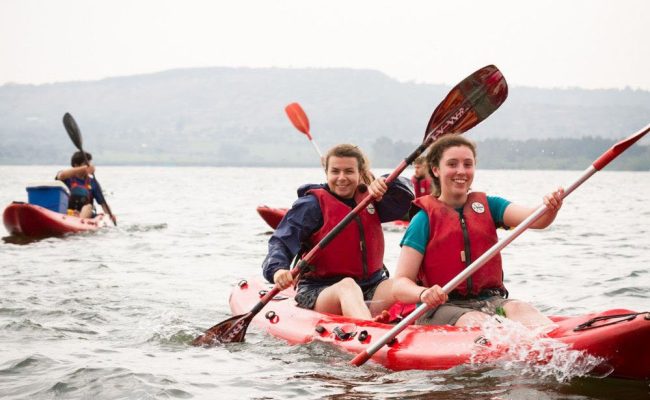
Afternoon — Boat or Mokoro Session on the Lagoon Where water levels and logistical arrangements permit, an afternoon session on Chunga Lagoon by boat or traditional mokoro — the dugout canoe of the Zambian waterways — transforms the birding experience from observation to immersion in a way that ground-based vehicle or walking encounters simply cannot replicate. From water level, the papyrus walls rise dramatically on both sides of the narrow channels, the birds within them suddenly at eye level rather than above, the perspective completely altered by the lowered viewpoint. African jacana walks on floating vegetation directly beside the boat. Malachite kingfisher perches on a papyrus stem within arm’s reach. The African pygmy goose pair that flushed from the open water and retreated to the papyrus margin is visible now through a gap in the stems, the male’s extraordinary colours visible in full detail at a distance of three metres. And in the deeper papyrus channels, patient slow-moving progress occasionally reveals the shoebill — standing motionless in a patch of shallow water among the papyrus stems, its massive bill resting on its chest, regarding the approaching boat with the magnificent indifference of an animal that has no natural predators and very little interest in the opinions of others. A shoebill encountered from a mokoro at close range, in its natural papyrus habitat, is one of the ornithological experiences of a lifetime — an encounter so completely strange and so completely real that the photograph afterward never quite convinces the viewer that what they are looking at is an actual living bird and not a very convincing illustration from a Victorian natural history volume.
Late Afternoon — Roost Flights & Evening Activity The late afternoon at Lochinvar produces one of the Kafue Flats’ most spectacular daily events — the pre-roost gathering and roost flights of the waterbird community. As the sun drops toward the western horizon, the egret and heron species that have dispersed across the floodplain during the day begin their return flights to communal roost sites — first as trickles of individuals, then as steady streams, and finally as rivers of white birds moving against the orange western sky in numbers that can reach tens of thousands. Yellow-billed storks gather in groups on the open floodplain before lifting off together in spiralling columns. Open-billed stork — a species whose bizarre bill, adapted for extracting freshwater mussels from their shells, gives it a permanently gap-toothed appearance — moves in loose flocks across the lagoon. And above everything, the swifts and swallows that have spent the day over the open water make their final evening circuits in diminishing spirals as the light fails and the first stars appear above the enormous Kafue Flats sky.
Day 3 — Northern Floodplain, Migratory Species & Departure
Dawn — Migratory Wader Concentration The third morning opens with a focused session on the seasonal and permanent shallow water margins where migratory wader species concentrate in numbers during the austral summer months — roughly October through March — when Palearctic breeding birds have descended from their Arctic and sub-Arctic breeding grounds to spend the northern winter on African wetlands. The Kafue Flats are among the most important wintering grounds for Palearctic waders in southern Africa, and the sheer numbers of common sandpiper, wood sandpiper, little stint, curlew sandpiper, ruff, and marsh sandpiper that concentrate on the floodplain margins during peak migration periods are sufficient to make serious wader birders plan their entire African itinerary around the timing. The challenge — and the pleasure — of wader identification at these concentrations is the mix of species in breeding, non-breeding, and transitional plumages that occurs during the migration periods, requiring the careful systematic approach that the specialist guide facilitates with patient, methodical working through each flock. Near-threatened species like the black-tailed godwit and the Eurasian curlew — both in significant long-term population decline across their Palearctic breeding ranges — occur regularly on the Kafue Flats, and their presence in this southern African wetland is a reminder of the global connectivity of migratory bird populations and the importance of protecting wetland habitats at both ends of the flyway.
Morning — Northern Sector & Grassland Specialists The northern sector of Lochinvar — the area of open floodplain grassland between the park’s woodland edge and the Kafue River’s main channel — holds a grassland bird community that complements the wetland species of the lagoon circuit with species adapted to the open, seasonally inundated grassland rather than the permanent water margins. Black-winged pratincole — an elegant, tern-like wader that breeds in colonies on the open floodplain and hunts flying insects on the wing with swallow-like agility — occurs in huge concentrations on the Kafue Flats, the colonies sometimes numbering in the thousands and the wheeling flocks over the grassland creating one of the most dynamic aerial wildlife displays on the African continent. African wattled lapwing — a large, yellow-wattled plover of the floodplain margin — is abundant and conspicuous. Denham’s bustard and kori bustard — the latter the world’s heaviest flying bird — stride across the open grassland with the deliberate authority of birds that have no need of camouflage. And in the grassland patches between the floodplain channels, the various cisticola species that make the open grassland their home — each identified by subtle combinations of head pattern, tail length, and the specific call that is usually the reliable separator between closely similar species — challenge and reward the identification skills that the guide brings to each encounter.
Midday — Park Headquarters & Conservation Context A midday stop at Lochinvar’s park headquarters allows a conversation with the Zambia Wildlife Authority rangers and researchers whose daily work maintains the park and monitors its wildlife populations — a conversation that provides essential context for the birding experience by connecting the species list accumulated across three days to the conservation challenges and successes that determine whether those species will be present for future visitors. The Kafue Flats face significant and growing pressures — upstream water extraction from the Kafue River, agricultural encroachment on the seasonal floodplain margins, illegal hunting, and the longer-term threat of altered flood regimes from upstream hydroelectric operations — that make the continued health of the Lochinvar ecosystem dependent on active, funded, well-staffed conservation management. Understanding these challenges, and the specific interventions that the parks authority and its partners are implementing to address them, transforms the birding experience from a passive consumption of natural abundance into an informed engagement with a conservation story that is genuinely uncertain in its long-term outcome and genuinely important in its global implications.
Afternoon — Final Lagoon Session & Species Review The final afternoon birding session returns to Chunga Lagoon for a last hour of watching and listing — a valedictory circuit of the water that has been the consistent centrepiece of three days of extraordinary birding. Species seen on the first afternoon but only glimpsed or incompletely observed are revisited with the accumulated knowledge of two full days of Lochinvar birding — the spatial knowledge of which parts of the lagoon hold which species at which times of day, the behavioural knowledge of how particular species use the habitat, and the perceptual knowledge of what to look for and how to look that builds across days of focused attention in a productive birding environment. A comprehensive species review with the guide — working through the list accumulated across the three days, confirming identifications, addressing any uncertainties, and discussing the ecological significance of the species composition observed — closes the ornithological content of the itinerary with the intellectual satisfaction of understanding rather than merely recording.
Late Afternoon — Departure The drive back to Monze and north toward Lusaka reverses the journey of day one across the Kafue Flats escarpment — the vast flat landscape of the flats visible one final time from the escarpment edge before the road climbs back onto the Zambian plateau and the woodland closes around the vehicle. The bird list accumulated across three days of focused expert-guided birding at Lochinvar will typically exceed 200 species for an attentive visitor in appropriate season — a figure that reflects the extraordinary ornithological richness of the Kafue Flats ecosystem and the quality of the guiding that the best Lochinvar operators provide. The numbers matter less, ultimately, than the specific encounters that the list represents — the shoebill in the papyrus channel, the wattled crane on the open floodplain at dawn, the yellow-billed stork roost flight against the evening sky, the sheer improbable abundance of a wetland that the world has somehow overlooked while it quietly hosts one of Africa’s greatest concentrations of birds going about their ancient, purposeful, magnificently indifferent lives.
Practical Notes
Best Season for Lochinvar birding divides meaningfully by target experience. The dry season from May through October offers the easiest access — tracks are passable, wildlife concentrates around permanent water, and the lagoon margins are accessible for walking. The wet season from November through April brings the Palearctic migrants and dramatically increases species totals, but also brings logistical challenges — tracks become impassable in the peak wet months of January and February, and access to the northern floodplain sectors requires specialist vehicles and local knowledge. The shoulder months of October-November and March-April offer the best combination of access and species diversity.
Specialist Operators with genuine Kafue Flats expertise are few but excellent — Zambia-based operators including Remote Africa Safaris, Wilderness Safaris Zambia, and several Lusaka-based specialist birding guides with specific Lochinvar experience are the appropriate resource for organising this itinerary. The difference between visiting Lochinvar with a specialist flats guide and visiting independently or with a general wildlife guide is the difference between a good day out and a transformative ornithological experience.
Accommodation within Lochinvar is basic — the national parks chalets at the main camp are functional and appropriately situated but modest in their facilities. Visitors requiring greater comfort typically base themselves at lodges near Monze and make daily excursions into the park, or arrange private camping within the park boundary through specialist operators who bring their own equipment and catering.
Combining with Blue Lagoon National Park on the northern bank of the Kafue Flats — a mirror image of Lochinvar in its habitat and species composition, slightly less visited and slightly more difficult of access — extends the Kafue Flats birding experience and adds species that the southern bank does not reliably produce, creating a complete flats experience that serious birders find entirely justifies the additional logistics.
Photography at Lochinvar rewards wide-angle landscape work — the scale of the floodplain and the density of waterbird concentrations at the lagoon are most powerfully captured in images that include both the birds and the vast flat landscape they inhabit — as well as the close portrait work that the boat and mokoro sessions enable at the lagoon’s papyrus margins. Early morning and late afternoon light on the open floodplain, with the enormous Kafue sky providing a backdrop of constantly changing drama, produces conditions that serious wildlife photographers travel specifically to experience.


 Email us bookings@twijaafrica.com
 Call us +256 777 559835