Duration: 11 Days / 10 Nights
Destinations: Kigali → Akagera → Nyungwe → Volcanoes
KIGALI — The City That Rebuilt Itself
Kigali is unlike any other African capital. It is clean — startlingly, almost unnervingly clean — with smooth roads, manicured roundabouts bursting with bougainvillea, and a skyline of glass towers rising above steep, forested hills that roll away in every direction. This is a city that has performed one of the most remarkable acts of collective will in modern history, pulling itself from the ashes of unimaginable tragedy in 1994 to become one of the most orderly, progressive, and forward-thinking cities on the continent. Plastic bags are banned. Motorcycle taxis wear matching helmets. The streets are swept every Saturday morning by citizens who come out voluntarily, together, in a national practice called Umuganda. And yet beneath all this modernity, Kigali breathes with genuine warmth — the markets overflow with colour and noise, the restaurants serve brochettes and isombe and ice-cold Primus beer, and the people carry their extraordinary history with a dignity and grace that is deeply, profoundly humbling. The Kigali Genocide Memorial is a place that every visitor must go, and no visitor will leave unchanged. It is one of the most important sites in the world — a place of sorrow, yes, but also of extraordinary resilience, and ultimately of hope.
kigali city tours
AKAGERA NATIONAL PARK — Rwanda’s Wild East
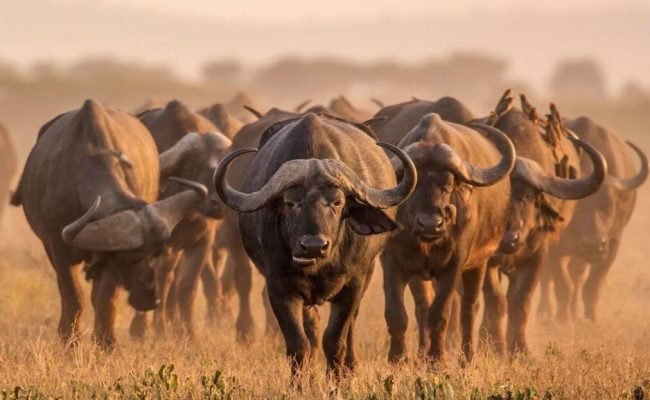
Drive east from Kigali and the landscape transforms completely. The city and its hills give way to a wide, low, sun-baked savanna studded with acacia and borassus palms, bisected by the sinuous Akagera River and its chain of glittering lakes — Ihema, Shakani, Rwanyakizinga — that stretch along the Tanzanian border like a string of mirrors. Akagera National Park is one of Africa’s great conservation comeback stories. Poached to near-collapse in the years following the genocide, it was revived through a remarkable partnership between the Rwandan government and African Parks, and today the results are staggering. Lions were reintroduced in 2015 — the first in Rwanda for decades — and have thrived. Black rhinos followed in 2017, completing the Big Five in a park that once had none. Today Akagera feels wild and vital and alive in a way that surprises even seasoned safari-goers. Elephant herds move between the lakes and the open plains. Hippos pack the river channels so densely they seem to pave the water. Enormous Nile crocodiles sun themselves on sandbanks with the languid confidence of creatures that have not needed to evolve in sixty-five million years. Topi antelope and roan, rare across East Africa, graze in the open grassland. And on a boat safari on Lake Ihema at dawn, with the mist still lying across the water and a fish eagle calling from a dead tree on the far bank, Akagera reveals itself as something deeply, quietly magnificent — a park still finding its full power, still rewilding itself, and all the more thrilling for it.
NYUNGWE FOREST NATIONAL PARK — The Ancient Green Heart
If Akagera is Rwanda’s open savanna, Nyungwe is its opposite in every conceivable way — and it is extraordinary. This is one of the oldest and most biodiverse montane rainforests in Africa, a vast, ancient, dripping cathedral of trees that has existed continuously for over a million years, surviving ice ages and climate shifts that destroyed forests across the rest of the continent. It covers over a thousand square kilometres of the Congo-Nile Divide, and standing at its edge, looking out over an ocean of unbroken green canopy rolling away across the hills in every direction, you feel the weight of geological time pressing gently on your shoulders. Nyungwe is home to thirteen species of primate — more than almost anywhere else in Africa — and chimpanzee trekking here is a raw, physical, deeply moving experience unlike the organised calm of gorilla trekking. Chimps move fast and loud and chaotically through the forest, screaming and crashing through the canopy, displaying their power and social complexity with theatrical abandon. To stand beneath a tree while forty chimpanzees argue above your head is to feel something ancient stir in your own biology — a recognition, deep and instinctive, of kinship. The colobus monkeys of Nyungwe move in troops of three, four, five hundred individuals — the largest troops anywhere on Earth — flowing through the canopy like a great black-and-white river. The forest itself is alive with the sound of invisible birds — over three hundred species call Nyungwe home — and the canopy walkway, suspended high above the forest floor, offers a perspective on this green world that is simultaneously terrifying and transcendent. In the morning, with the mist filling the valleys below you and the forest steaming gently in the first light, Nyungwe feels like the beginning of the world.
VOLCANOES NATIONAL PARK — Face to Face with the Mountain Gorillas
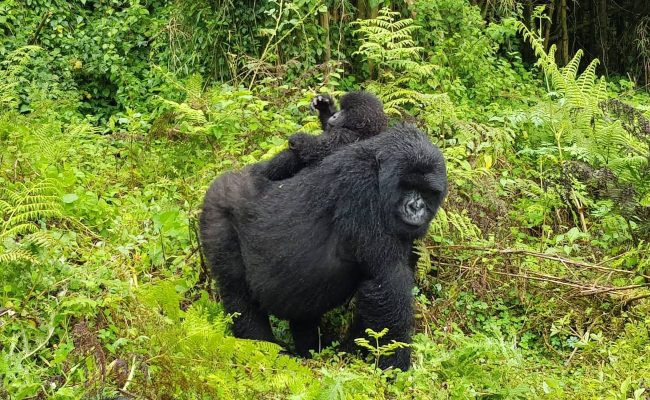
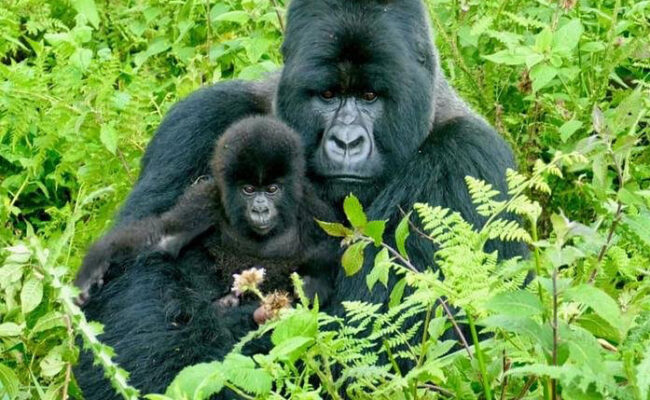
There are a handful of experiences in the natural world that change you. Not in the shallow, Instagram-caption sense of the word, but genuinely, permanently, at the level of something you cannot fully articulate — the level where language runs out and you are left with something wordless and irreversible. Gorilla trekking in Volcanoes National Park is one of those experiences. You begin before dawn in the village of Kinigi, at the foot of the Virunga volcanoes, in the cool mountain air at 2,000 metres, the great dark cones of Karisimbi, Bisoke, and Sabyinyo rising above you in the half-light. You are given your gorilla family assignment, your briefing, and then you walk — through potato fields that press right to the edge of the park boundary, through the bamboo zone where the stalks close around you like a green tunnel, and then into the deep interior of the hagenia forest, where the trees are draped in old man’s beard moss and the ground is soft and black and the silence is broken only by birdsong and the sound of your own breathing. The trek can take an hour. It can take five. It does not matter. When your guide drops to one knee and whispers that the family is just ahead, and you push through a last wall of undergrowth and find yourself three metres from a silverback — an adult male mountain gorilla weighing 200 kilograms, sitting in a shaft of dappled light eating wild celery with an expression of absolute, unhurried peace — time stops. He looks at you. Not through you, not past you — at you. With eyes that are dark and deep and luminously, uncomfortably intelligent. Eyes that hold something you recognise without being able to name it. You are allowed one hour with the family, and in that hour you will watch mothers nursing infants, juveniles tumbling and play-fighting through the undergrowth, adolescents watching you with a curiosity that mirrors your own. Mountain gorillas are critically endangered — fewer than 1,100 remain on Earth, all of them in these Virunga mountains. The money from your permit goes directly to their protection. The conservation model here, pioneered by Rwanda, is one of the most successful in the world — gorilla numbers have actually increased over the last two decades, a rare and precious conservation triumph. And when you walk back out of the forest, blinking in the afternoon light, your boots thick with red mud, you will find that you are not quite the same person who walked in. Something has shifted. Something has been given to you by those mountains and those animals that you did not know you were missing, and that you will carry with you, quietly and carefully, for the rest of your life.
2 Days Gorilla Trek Rwanda
2 Days Akagera National Park Safari
3 Days Akagera National Park Wildlife Safari
4 Days Northern Parks Extension
Rwanda Gorillas Adventure 5 Days/4 Nights (Comfort)
6 Days South Sudan Tour (General)
7 Days Zambia Safari Adventure – Livingstone & Kafue
8 Days Discover Rwanda Gorillas, Chimps, Dian Fossey Tour (Exclusively Private)
9 Days Rwanda Tour
10 Days Exploring the Wonders of Zambia
11 Days Rwanda Wildlife Luxury Safari
3 Days Mundari Cattle Camp Tour
Wild West Zambia – 15 Days / 14 Nights


 Email us bookings@twijaafrica.com
 Call us +256 777 559835